

GPTZero is the best known AI detector on the market, and the number it leads with is 99.9% accuracy. That number is real, it is published, and it is not the one you should be making decisions on.
The number that matters is buried three sentences deeper in the same paragraph: a 1% false positive rate. That is the rate at which genuinely human writing gets flagged as AI. For a tool whose output can start a misconduct conversation about a real student, one percent is the entire story, and almost nobody does the arithmetic on it.
So this guide does. Below: what GPTZero actually costs, which of its dozen tools are worth having, what its own accuracy claims mean when you put them side by side, and what a 1% false positive rate looks like across a real teaching year.
Quick Picks
| If you are… | Plan | Price | Why |
|---|---|---|---|
| Checking the odd document | Free | $0 | The detector is usable without paying. Start here before anything else |
| A student protecting your own work | Essential | $8.33/mo annual | 150,000 words, plus plagiarism and grammar. Writing Replay matters more than the scan |
| A teacher marking a full timetable | Premium | $12.99/mo annual | 300,000 words, Advanced Deep Scan, downloadable reports you can actually show someone |
| Marking in French, German, Spanish or Portuguese | Premium | $12.99/mo annual | Multilingual detection starts here, not on Essential |
| Buying on volume alone | Premium | $12.99/mo annual | Best value per word in the range. Professional costs more per word, not less |
| Running a department or an institution | Professional | $24.99/mo annual | 250-file batch scanning, page-by-page detection, LMS security integration |
| Screening job applicants | Professional or API | From $24.99/mo | Zapier and the API handle this better than the web app |
| A teacher who wants it free | Educator programme | $0 | GPTZero grants Premium for life, which it values at $288/year |
How I Checked This
Everything here comes from GPTZero’s own pages and published structured data, read on October 28, 2026, rather than from secondary coverage.
One note on method, because it changes what you can trust. The pricing page renders its plan table in the browser, so the prices are not in the page source and a plain fetch returns empty placeholders. The real figures are published in the page’s JSON-LD, as Offer nodes carrying exact prices, billing durations and word allowances. That is where the numbers below come from, and it is the same data Google reads. A normal visitor sees these prices perfectly well; it was only my fetching that could not, so nothing here implies GPTZero conceals them.
I have not run detection jobs through the product, so there is no independent accuracy measurement here and nothing below is a test result. What follows is an analysis of what the company publishes about its own pricing and performance, including the places where two of its own numbers describe different things.
The Plans, From the Structured Data
| Plan | Monthly | Annual (per month) | Annual total | Words/month | Cost per 1,000 words |
|---|---|---|---|---|---|
| Free | $0 | $0 | $0 | Not published | n/a |
| Essential | $9.99 | $8.33 | $99.96 | 150,000 | $0.056 |
| Premium | $15.99 | $12.99 | $155.88 | 300,000 | $0.043 |
| Professional | $29.99 | $24.99 | $299.88 | 500,000 | $0.050 |
What each tier adds, in the company’s own words:
- Essential: “Basic AI Scan, Premium AI detection models, Plagiarism scanning, and Grammar feedback.”
- Premium: “everything in Essential plus Advanced AI Deep Scan, Multilingual detection, and downloadable AI reports.”
- Professional: “all Premium features plus 10 million word overage, 250-file scanning, page-by-page detection, and enterprise-grade LMS security integration.”
There is also a Professional Team Plan, buyable without a sales call, with shared team credits, unified billing, 500,000 words per member per month and a two seat minimum. It is card payment only; purchase orders and larger teams go through sales.
Premium is the value pick, and Professional is not
Work out cost per 1,000 words of monthly allowance and the ladder stops being a ladder. Essential is $0.056, Premium is $0.043, and Professional goes back up to $0.050.
So Professional is more expensive per word than the tier below it. That is not a trap, it just means Professional is sold on capability rather than volume: batch scanning 250 files at once, page-by-page detection, the LMS integration and a ten million word overage allowance. If you are buying on throughput alone, Premium wins and the upgrade is a downgrade in value per word.
The annual discount does not reconcile
The pricing page advertises “Annual (Save 45%)”. Against the monthly and annual prices GPTZero publishes in its own structured data, the real saving is nothing like that:
| Plan | Monthly × 12 | Annual price | Actual saving | Advertised |
|---|---|---|---|---|
| Essential | $119.88 | $99.96 | 16.6% | 45% |
| Premium | $191.88 | $155.88 | 18.8% | 45% |
| Professional | $359.88 | $299.88 | 16.7% | 45% |
There is a plausible explanation, and it is worth stating because it is probably not deceit. GPTZero’s educator page values a Premium licence at “$288/year”, which works out at $24 a month. Measure the $155.88 annual price against $288 rather than against $191.88 and you get 45.9%, which is where the 45% almost certainly comes from. In other words the discount appears to be calculated against an older or list monthly rate of $24, while the monthly toggle now charges $15.99.
Either way, the practical advice is the same: annual billing saves you roughly a sixth, not getting on for a half. On Premium that is $36 a year. Still worth taking, just not worth rearranging your budget for.
What “99.9% Accuracy” Is Measuring
GPTZero publishes several accuracy numbers, and the useful thing is that they are all in one paragraph of its own FAQ, so you can line them up without hunting:
“Independent benchmarks, like our partners at Penn State’s AI Research Lab, and our own large-scale testing show that GPTZero is the most accurate AI detector, with a 99.9% accuracy rate when spotting AI-generated text vs. human writing. This aggregate accuracy covers human and AI-written samples, while keeping misclassification of text to an absolute minimum. Our results were further validated on RAID, a comprehensive, third-party benchmark where GPTZero was shown to be the most accurate AI detector in North America, detecting 95.7% of AI texts while only incorrectly predicting 1% of human texts as AI, an accuracy that jumps to over 99% when filtering to modern LLMs like GPT4.”
Four different figures, and they are not interchangeable:
| Figure | What it describes |
|---|---|
| 99.9% | Aggregate accuracy over a mixed set of human and AI samples, from internal testing plus partner benchmarks |
| 95.7% | Share of AI texts correctly caught on the third-party RAID benchmark |
| Over 99% | The same measure, but only counting text from recent models such as GPT-4 |
| 96.5% | Accuracy on “mixed documents” where human and AI writing are combined |
| 1% | Human texts wrongly predicted as AI. The false positive rate |
An aggregate accuracy figure across a balanced set of human and AI samples is a reasonable thing to publish, and 99.9% on that measure is a strong result. It is simply not the quantity a teacher is exposed to. A teacher runs overwhelmingly human documents through a detector. The number governing their experience is the false positive rate, and GPTZero states it plainly: 1%.
Credit where it is due here, because this is unusual. Most detectors do not publish a false positive rate at all. GPTZero publishes one, names a third-party benchmark rather than only its own testing, and says in the same breath that “no AI detector can ever truly be 100% perfect.” That is a more honest disclosure than this category generally manages.
What 1% looks like across a teaching year
A rate only becomes meaningful at volume, so here is the arithmetic, assuming the stated 1% holds for the documents you are scanning:
| Scenario | Human documents scanned | Expected false flags |
|---|---|---|
| One class of 30, a single essay | 30 | 0.3 |
| One class of 30, ten assignments | 300 | about 3 |
| A teacher with 120 students, eight assignments | 960 | about 10 |
| A department scanning 20,000 submissions | 20,000 | about 200 |
Those are expected values, not certainties, and a lower rate than most competitors would produce. But read the second row again: a single teacher, a single class, one normal school year, and the tool is expected to flag roughly three pieces of genuinely human work. Scale it to a department and you are looking at hundreds of innocent students a year whose essay came back with a number next to it.
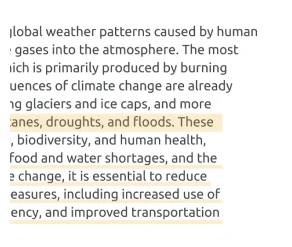
This is the whole reason a detector score cannot function as evidence on its own, and GPTZero broadly agrees. Its own student page says the company is “not about ‘catching students'” and promises “a collaborative approach over a punitive one”. Randi Weingarten, president of the American Federation of Teachers, which GPTZero partners with, describes the product as “a magnifying glass to help teachers get a closer look behind the scenes of a document”. A magnifying glass is a good metaphor. It is an instrument for looking more closely, not a verdict.
Two caveats GPTZero states itself
Short text is less reliable. In its own words, “accuracy improves with longer inputs (document-level results are stronger than paragraph or sentence-level) and is strongest on English prose.” Scanning a paragraph is the worst way to use this tool, and the sentence-level highlighting, useful as it is, is the least reliable layer of the output.
Non-native English writing has been a known problem in this category. GPTZero addresses it directly: it describes itself as “the only AI detector de-biased for ESL (English Second Language) learners” and says “we repeatedly train our model to reduce false positive rate for ESL writing to 1%.” Publishing that target at all is to their credit. It also tells you the honest thing, which is that ESL writing needed specific work to reach parity, and if you teach a lot of it, this is the figure to ask about rather than the 99.9%.
The Tools Worth Having
GPTZero is no longer one detector. The catalogue runs to about a dozen tools, and they fall into three useful groups.
Detection. The AI Detector and Advanced AI Scan are the core. AI Vocabulary flags words current models overuse. AI Vision handles images. The detector currently names GPT-4.1 and 4.1-mini, o3 and o3-mini, Gemini 2.5 Pro, Flash and Flash-Lite, and Claude Sonnet 4 among the models it covers, which is a more specific disclosure than most competitors offer.
Verification. The Plagiarism Checker, the Citation and Fact Checker, and the Hallucination Detector, which looks for fabricated claims rather than AI phrasing. That last one is arguably the more future-proof product: as models get better at sounding human, detecting whether a claim is true outlasts detecting whether a sentence was typed by a person.
Proving you wrote it. Authorship Verification, Expert Feedback, the Grammar Checker and Writing Replay, which the company describes as letting you “watch documents being written, view copy and pastes, and check for unnatural typing patterns”, delivered through the Origin Chrome extension.
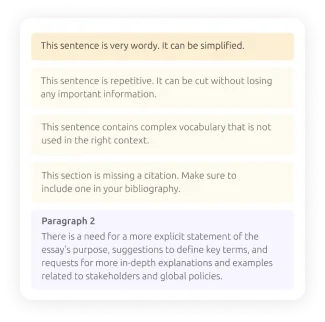
That third group deserves attention, because it is the honest response to a 1% false positive rate. If your detector will sometimes flag innocent work, the right thing to build is a way for innocent people to prove themselves, and GPTZero has built it. For a student, Writing Replay is a better reason to have an account than the detector is.
Integrations and the API
The web app is not the interesting surface. GPTZero ships integrations for Google Docs, Google Classroom, Canvas, Chrome, Zapier and a REST API, with sample code the company says covers 17 languages.
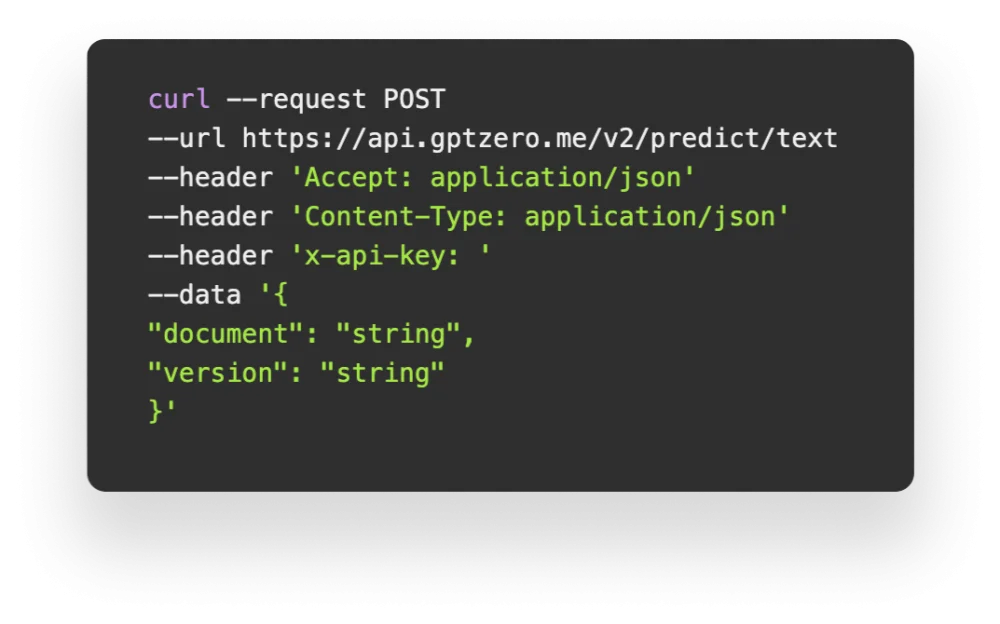
The Zapier integration opens up a use case the marketing underplays: screening inbound writing that is not coursework at all. GPTZero’s own example wires an applicant tracking system to the detector and out to a spreadsheet.
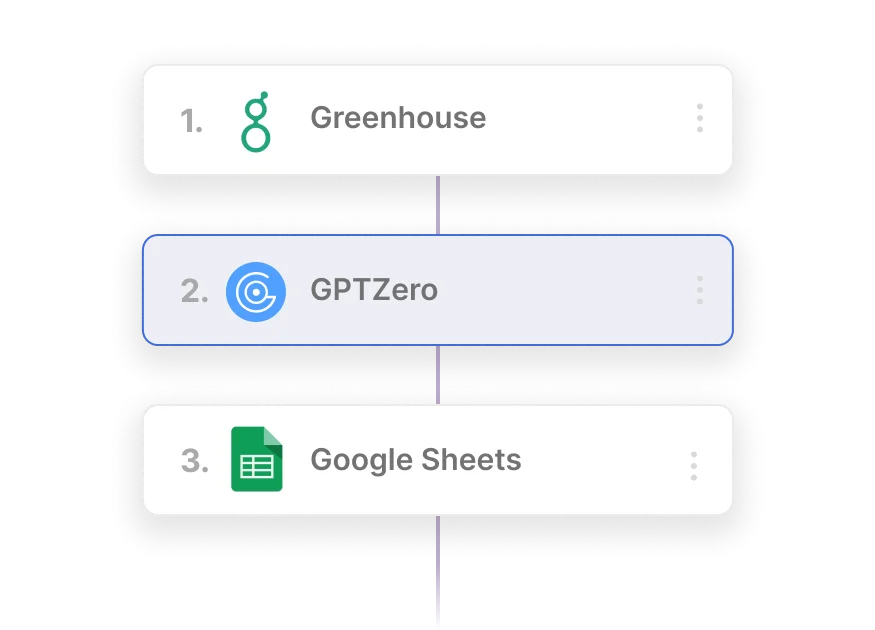
If you build that workflow, build the human step into it as well. A 1% false positive rate applied to a hiring funnel is the same arithmetic with worse consequences, and a cover letter is short text, which is the condition GPTZero itself says its accuracy is weakest under.
What GPTZero Gets Right
It publishes the uncomfortable number. A stated false positive rate, a named third-party benchmark, an explicit admission that perfection is unavailable, and a documented ESL bias programme. Competitors mostly publish a single accuracy percentage and stop.
Interpretability. The company claims to be “the only detector that explains exactly why text is AI with natural language”, with colour-coded sentence highlighting. Whether or not the exclusivity claim holds, showing which sentences triggered a result is the difference between something a teacher can discuss and something they can only act on.
It built the defence as well as the accusation. Writing Replay and Authorship Verification exist so a student can demonstrate their process. That is a company taking its own error rate seriously.
The free tier is real. You can run the detector without paying, which means you can evaluate the thing that matters before any money moves.
The educator programme. Premium for life, valued at $288 a year, plus community and certification. For an individual teacher the correct price of this product may well be nothing.
Who Should Skip It
- Anyone wanting a verdict rather than a signal. If you intend to treat a percentage as proof, no detector is suitable, and this one says so itself.
- Anyone scanning short text. Accuracy is weakest on paragraphs and sentences. Cover letters, forum posts and discussion answers are the worst case.
- Teachers working mainly outside the five supported languages. English, German, Portuguese, French and Spanish get full support. Everything else is unquantified.
- Buyers choosing Professional for volume. It costs more per word than Premium. Buy it for batch scanning and LMS integration or do not buy it.
- Teachers who have not checked the educator programme. Do that before paying for anything.
Frequently Asked Questions
How much does GPTZero cost?
There is a free tier. Paid plans are $9.99, $15.99 and $29.99 a month, or $99.96, $155.88 and $299.88 a year for Essential, Premium and Professional, carrying 150,000, 300,000 and 500,000 words a month.
Is the annual discount really 45%?
Measured against the monthly prices GPTZero publishes, no. The real saving is 16.6% to 18.8%. The 45% figure reconciles only against a $24 monthly rate, which is what the educator page’s “$288/year” valuation implies.
How accurate is GPTZero?
The company claims 99.9% aggregate accuracy, and separately reports 95.7% detection of AI texts with a 1% false positive rate on the third-party RAID benchmark, rising above 99% for recent models and 96.5% on mixed human and AI documents.
Can it wrongly accuse a student?
Yes, and GPTZero does not pretend otherwise. At its stated 1% false positive rate, a teacher scanning 300 genuinely human assignments a year should expect roughly three false flags. A score is a reason to look closer, not a finding.
Does it work for non-native English writers?
GPTZero says it is the only detector de-biased for ESL writing and that it trains the ESL false positive rate down to 1%. If you teach mainly ESL students, ask about that figure specifically.
Which languages does it support?
Full support for English, German, Portuguese, French and Spanish. Multilingual detection requires Premium or above.
Is there a free plan?
Yes. The detector is usable without payment, and teachers can apply to the educator programme for Premium at no cost.
Final Thoughts
GPTZero is the strongest product in an uncomfortable category, and it is uncomfortable for reasons no vendor can engineer away. Detection is probabilistic, the people it is pointed at are usually innocent, and the consequences of being wrong land on a student rather than on the software.
What distinguishes GPTZero is that it mostly behaves as though it knows this. It publishes a false positive rate, names an external benchmark, states that no detector is perfect, works specifically on ESL bias, shows which sentences triggered a result, and has built an entire product line so writers can prove authorship rather than merely be judged on it. That is a more serious posture than a 99.9% badge on a landing page would suggest, and it is the real reason to pick this one.
Buy it with the right number in your head. Not 99.9%, which describes a balanced test set you will never face, but 1%, which describes your Tuesday. Premium at $12.99 a month billed annually is the sensible tier and the best value per word in the range; Professional earns its price through batch scanning and LMS integration rather than volume; and if you teach, check the educator programme before you pay at all. Then treat every flag as the beginning of a conversation. The tool is good enough to be worth running, and nowhere near good enough to be the last word.
Worth remembering what sits on the other side of this market too: the AI video generators we reviewed recently are improving faster than the detectors chasing them, which is exactly why a hallucination checker may outlive an AI detector. The rest of our software coverage follows both sides.
You can run the detector for free and see the plan tiers on GPTZero’s site before committing to anything.


Write Your Review
No reviews yet. Be the first to share your experience!