

If you went looking for OpenPhone and ended up here, you are in the right place. OpenPhone announced it was renaming itself Quo on September 23, 2025, alongside a $105 million raise. Same company, same founders, same app.
Thirteen months later the rename is still visibly half-finished. The pricing page invites you to “Try Quo risk-free for 7 days” near the top and “Try OpenPhone risk-free for 7 days” at the bottom. The same page explains that every user “added to your OpenPhone workspace” gets a number, and that support will port your number “into OpenPhone” for free. The footer belongs to OpenPhone Technologies, Inc.
None of that affects call quality. It is worth leading with anyway, because it tells you how to read everything else on the site: this is a company mid-transition, and the fine print has not all caught up. So here is what Quo actually costs, where the second and third meters sit, and the one plan boundary that matters far more than the price difference suggests.
Quick Picks
| If you are… | Plan | Per user/month | Why |
|---|---|---|---|
| One person who wants a second number | Starter | $15 annual / $19 monthly | A real business line with texting, voicemail transcripts and an AI receptionist |
| A team of 2 to 10 sharing an inbox | Starter | $15 annual | Shared numbers work here, but the cap is 10 paid users |
| Running any CRM at all | Business | $23 annual / $33 monthly | Starter has zero CRM integrations. This is the real entry plan for most teams |
| Routing calls to departments | Business | $23 annual | Phone menus, call transfers, group calling and ring order all start here |
| In healthcare | Business | $23 annual | HIPAA ready is not available on Starter |
| Buying annually anyway | Business | $23 annual | Annual billing cuts the Starter to Business gap from $14 to $8 |
| After AI call tags and phone support | Scale | $35 annual / $47 monthly | Thin upgrade. Four additions over Business, three of them support |
| Needing a SOC 2 report | Talk to sales | n/a | Not included on any published plan, including the $47 one |
How I Checked This
Every figure here comes from Quo’s own pricing page, feature comparison table and rebrand announcement, read on October 23, 2026. The plan comparison was parsed from the page markup rather than from the rendered summary, because checkmark icons do not survive a plain text copy and getting a column wrong would misstate what a plan includes.
I have not run this phone system on a live business, so there is no call quality verdict here and nothing in this article is a test result. This is a pricing and plan boundary analysis, which is the part most reviews of business phone systems skim. Two things I could not retrieve: the Fair Usage Policy that every “Unlimited” on the page is asterisked to, and the affiliate and referral pages, because Quo’s robots.txt asks crawlers to stay out of those directories and I respected it.
What the Rebrand Changed
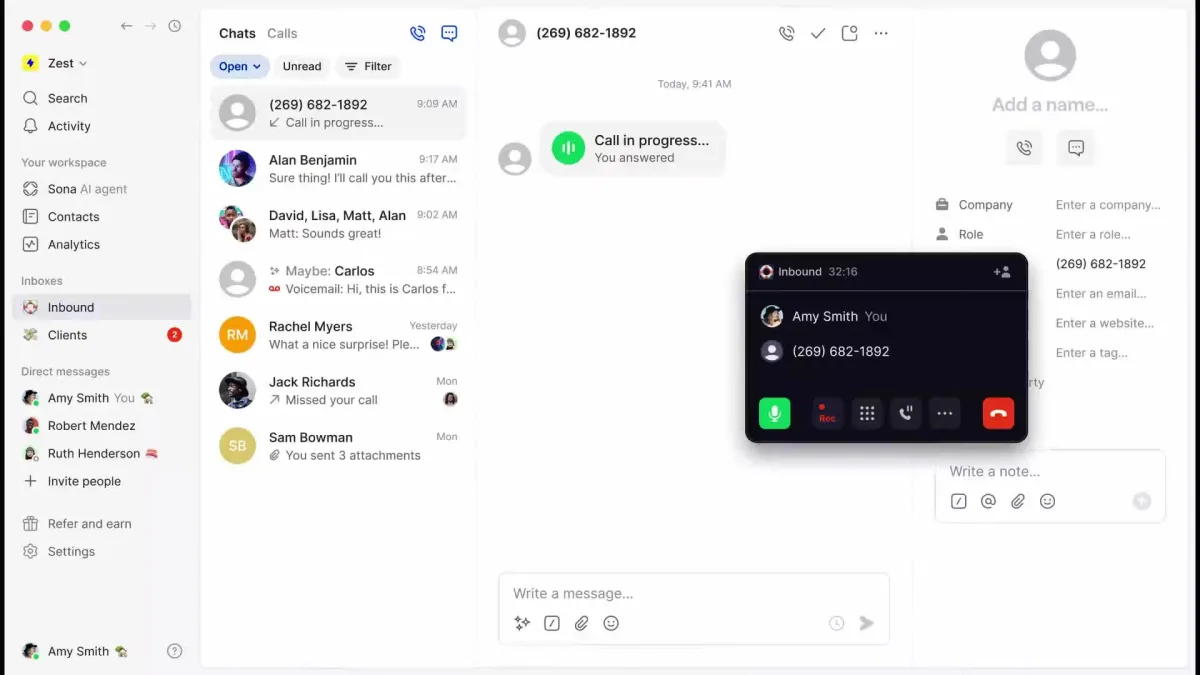
Almost nothing about the product, by the company’s own account. The announcement, written by co-founder and CEO Mahyar Raissi, says plainly: “This rebrand isn’t about changing the product you already know and trust.” It gives existing customers no migration step, no deadline and no action to take.
Two things did change around the same time, and both are on the pricing page. Sona, the AI agent that answers calls, is now included on every plan rather than sold separately, and it runs on a usage meter described below. The plan names are Starter, Business and Scale.
What the announcement does not do is explain the name. It says the company is “spotlighting what the phone makes possible: customer experiences that rise far above the status quo”, which gestures at the word without defining it. Neither announcement page says what Quo stands for, what happens to the openphone.com domain, or whether the old brand is being retired or kept.
That ambiguity is visible in the markup. The structured data on the rebrand pages still lists OpenPhone as an alternate name and as a brand, still gives the legal name as OpenPhone Technologies, Inc., and still links to openphone.com. If you are evaluating this product, the practical consequence is small but real: search results, old help articles, integration directories and your own invoices may use either name for a while.
The Three Plans
| Starter | Business | Scale | |
|---|---|---|---|
| Billed monthly | $19 | $33 | $47 |
| Billed annually | $15 | $23 | $35 |
| Annual cost per user | $180 | $276 | $420 |
| Annual saving | $48 (21%) | $120 (30%) | $144 (26%) |
| Shared number users | Up to 10 paid | Unlimited | Unlimited |
| CRM integrations | None | All 11 | All 11 |
| Phone menus, transfers, group calling | No | Yes | Yes |
| Call recording | Manual | Automatic | Automatic |
| Analytics and reporting | No | Yes | Yes |
| HIPAA ready | No | Yes | Yes |
| AI call summaries | Sona calls only | All calls | All calls |
| Open tasks | Up to 10 | Unlimited | Unlimited |
| Support | Email, live chat | Priority, inbound phone | |
| SOC 2 report, audit log | Talk to sales | Talk to sales | Talk to sales |
Note the annual discount column. It is 21 percent on Starter, 30 percent on Business and 26 percent on Scale. Most companies apply one flat percentage, so this is unusual, and it is the Business plan that gets the deepest cut.
Annual billing changes which plan you should buy
Billed monthly, moving from Starter to Business costs $14 per user per month. Billed annually, the same move costs $8. For a five-person team that is $480 a year rather than $840, and it buys the entire integration layer, call routing, analytics, automatic recording and HIPAA readiness.
So the usual advice is inverted here. Normally you take the cheap plan and upgrade when you outgrow it. On Quo, if you are going to pay annually at all, Business is close enough to Starter that the question becomes whether you can justify not taking it.
Starter Is a Different Product, Not a Smaller One
This is the finding that matters most, and the plan cards do not convey it. Starter is missing things a buyer would reasonably assume are in a business phone system at any price.
Every CRM integration is absent. Not reduced, absent. HubSpot, Salesforce, Zoho, Pipedrive, Attio, Clio, Jobber, Gong, HighLevel, HousecallPro and JobTread are all unavailable on Starter and all included on Business. That is eleven integrations, and logging calls and texts to a CRM is the single most common reason a small sales or service team buys a shared phone system in the first place.
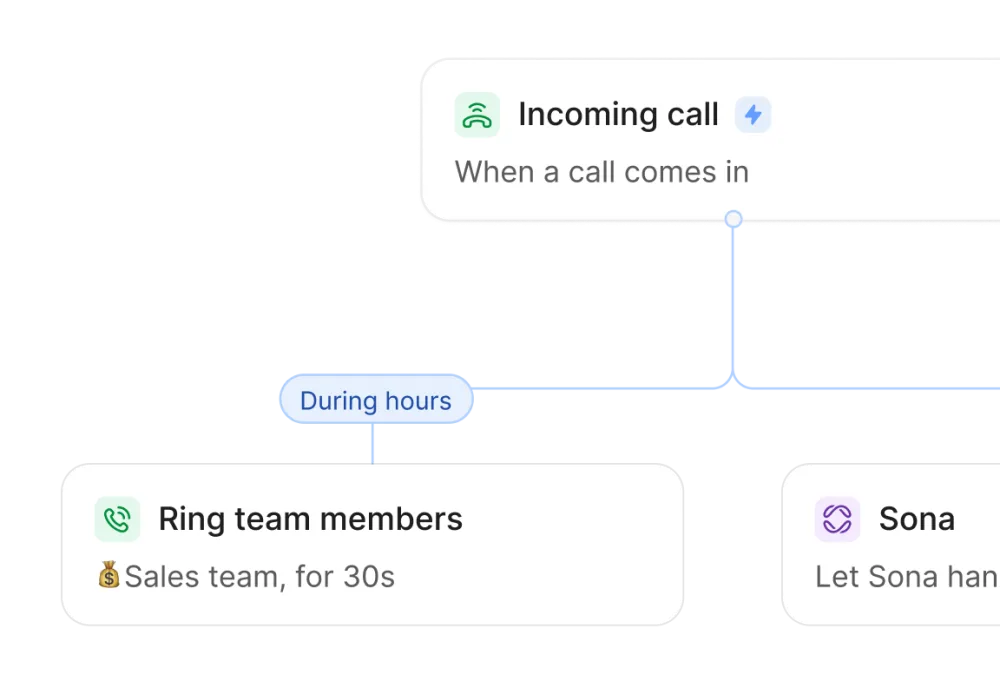
Call routing is absent. No phone menus, no call transfers, no group calling, no ring order, no advanced call forwarding. You can forward all calls to one other number and that is the extent of it. A team that wants “press 1 for sales” needs Business.
Call recording is manual only. You can hit record on a call. You cannot have calls recorded automatically, which is what most people actually mean when they ask whether a system records calls.
Analytics are absent, and HIPAA readiness is absent. The second matters if you are a clinic or a practice, and Quo markets answering services to chiropractic, healthcare and legal businesses.
AI call summaries only cover Sona calls. The transcripts and summaries apply to calls the AI agent handled, not to calls your team answered. The feature you are probably picturing is a Business feature.
Starter is still a genuinely good product for the right buyer. If you are a sole operator or a small team that wants a proper business number, a shared text inbox, voicemail transcripts and an AI receptionist for after hours, it does all of that for $15 a month. It simply is not a scaled-down version of the thing the marketing describes.
Scale Is the Thin Tier
Going from Business to Scale costs another $12 per user per month annually, or $14 monthly, and adds four things: AI call tags, dedicated onboarding support, priority live chat and email support, and inbound phone support.
Three of those four are support upgrades. The only new product capability is AI call tags, which applies your own labels to calls automatically. For a five-person team, Scale costs $720 a year more than Business.
That can be worth it. If you are running a support operation where being able to phone your vendor during an outage matters, inbound phone support is a reasonable thing to buy. Just buy it knowing that is mostly what you are buying.
Worth noting at both tiers: the SOC 2 report and the audit log are “Talk to Sales” on all three plans, including the $47 one. If your procurement process needs a SOC 2 report attached to a security review, no published plan gets you one without a conversation.
Sona Runs on a Second Meter
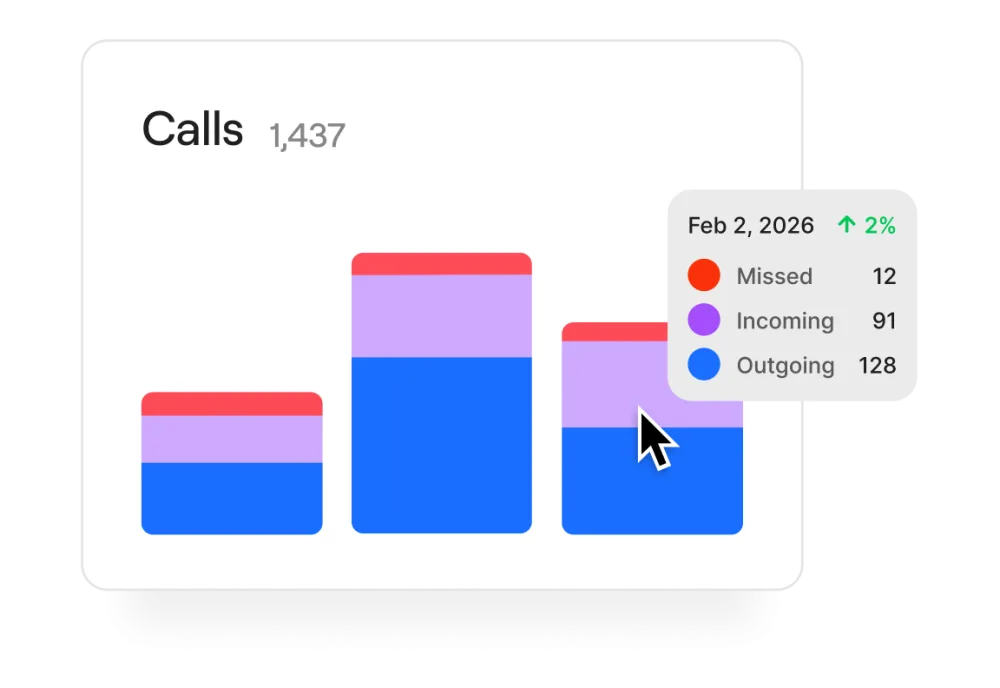
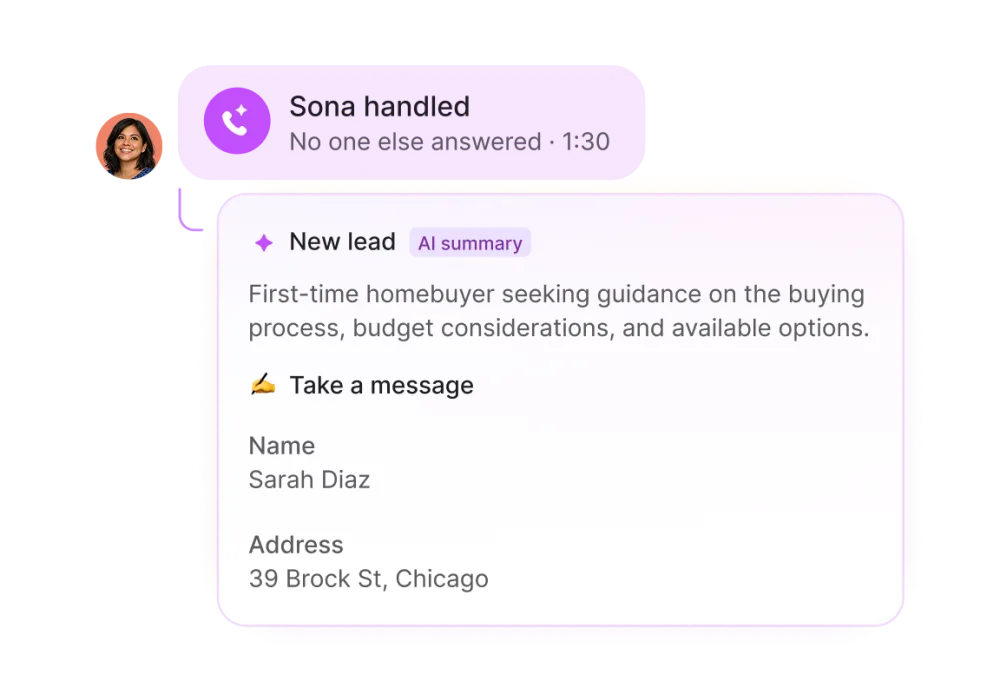
Sona is the AI agent that answers calls when nobody picks up. It is included on every plan, which sounds like it is free, and for ten calls a month it is. After that it runs on credits, where one call costs 100 credits and every plan includes 1,000 credits, or ten calls, per month.
Beyond that there are five tiers, and the thing to understand is that the overage rate at every tier is more expensive than the credits in that same tier:
| Tier | Price | Calls included | Effective rate | Overage per call | Overage premium |
|---|---|---|---|---|---|
| Tier 1 | $0 | 10 | Free | $1.00 | n/a |
| Tier 2 | $25/mo | 40 | $0.63 | $0.75 | +20% |
| Tier 3 | $49/mo | 100 | $0.49 | $0.65 | +33% |
| Tier 4 | $99/mo | 250 | $0.40 | $0.55 | +39% |
| Tier 5 | $199/mo | 600 | $0.33 | $0.45 | +36% |
Drifting along on overage is therefore always the expensive option. Working out the company’s own numbers, here is the call volume at which each tier starts beating the one below it:
| Move up when you pass | From | To | Cost at that point |
|---|---|---|---|
| 36 AI calls a month | Free tier | Tier 2, $25 | $26 vs $25 |
| 73 AI calls a month | Tier 2 | Tier 3, $49 | $49.75 vs $49 |
| 177 AI calls a month | Tier 3 | Tier 4, $99 | $99.05 vs $99 |
| 432 AI calls a month | Tier 4 | Tier 5, $199 | $199.10 vs $199 |
The free allowance is genuinely small. Ten AI-handled calls is a couple of days of missed calls for a busy trades business, and the first tier of overage is the most expensive per call in the whole table at a dollar each. If you intend to lean on the AI receptionist, price Tier 3 at $49 into your monthly cost from the start, and treat $15 a user plus $49 as the realistic number rather than $15.
The Costs That Are Not in the Headline Price
Three of these, and the first is close to mandatory.
Carrier registration fees. To get text messages reliably delivered to AT&T, T-Mobile and Verizon customers, US businesses must register with The Campaign Registry. Quo discloses this properly in the comparison table: a $19.50 one-time review fee, then $1.50 to $3 a month ongoing, both charged by the registry rather than by Quo. It is not optional in practice. If texting US customers is part of why you are buying, add it in.
Extra phone numbers are $5 a month each. Each user gets one number. A second number for a location, a department or a campaign is a separate line item on top of the per-user price.
Automated SMS costs a cent per segment. Texts sent through the API, Zapier or Make are billed at $0.01 per outgoing segment on every plan. Low, but it is a per-message meter rather than part of the unlimited allowance, and long messages split into multiple segments.
There is also an asterisk worth noticing. Calling and messaging to the US and Canada are listed as “Unlimited” on all three plans, with an asterisk pointing to a Fair Usage Policy. That is normal for the industry and not a criticism by itself. It does mean the word “unlimited” on this page is qualified by a document, and I was not able to read that document because the site’s robots.txt excludes the policies directory from crawlers.
What Quo Gets Right
The fee disclosure is better than the category norm. The Campaign Registry charges catch people out constantly with other providers. Quo puts them in the comparison table with the exact amounts and an explanation of who collects them. That is the opposite of hiding a fee, and it deserves saying.
The integration list is deep and specific. Beyond the obvious CRMs, Business includes Clio for law firms, Jobber and HousecallPro and JobTread for trades, and Gong for sales teams. These are the tools the industries Quo targets actually run, rather than a list padded with logos.
There is a published MCP connector. Quo exposes calls, texts and contacts to Claude and ChatGPT through MCP, on every plan including Starter. That puts it alongside the better-implemented examples I have looked at recently, such as Reclaim.ai’s MCP server, and it is a sensible thing to ship in 2026 rather than an afterthought.
Porting is free and supported. Moving an existing number in costs nothing beyond the usual per-number charges, with a documented process. For a business whose number is on its vehicles and its signage, that is the whole decision.
HighLevel users have a first-class path. If you are running an agency stack, the HighLevel integration logs calls, texts, voicemails, recordings and AI summaries back into it while keeping contacts in sync. Worth reading alongside what that platform costs per sub-account in my GoHighLevel pricing breakdown, since the two bills stack.
Who Should Skip Quo
- Anyone who needs a SOC 2 report without a sales call. It is gated on all three published plans.
- Teams over ten people who want to stay on Starter. The shared number cap is ten paid users, so growth forces the upgrade whether or not you wanted the features.
- Businesses that mostly call internationally. US and Canada are included; everywhere else is per minute or per message, billed through credits.
- Anyone expecting the AI receptionist to be free. Ten calls a month is the allowance, and the first overage tier is a dollar per call.
- Buyers who want a desk phone. This is an app on mobile and desktop that runs over the internet. If you want hardware handsets on desks, this is the wrong category of product.
Frequently Asked Questions
Is Quo the same as OpenPhone?
Yes. OpenPhone announced the rename to Quo on September 23, 2025, alongside a $105 million raise. The company, founders and product are the same, and the legal entity is still OpenPhone Technologies, Inc. Existing customers were given no migration step to perform.
What does Quo cost?
$19, $33 or $47 per user per month billed monthly, or $15, $23 or $35 billed annually, which works out to $180, $276 or $420 per user per year. Add carrier registration fees and any Sona credit tier on top.
Which plan do most teams need?
Business. Starter has no CRM integrations, no phone menus or call transfers, no analytics, manual-only call recording and no HIPAA readiness. Billed annually the gap is only $8 per user per month.
Is the AI receptionist included?
Sona is included on all plans, but only for ten calls a month. Beyond that it is $25, $49, $99 or $199 a month depending on volume, with overage from $0.45 to $1.00 per call.
Are there hidden fees?
Nothing hidden, but three charges sit outside the headline price: The Campaign Registry’s $19.50 one-time and $1.50 to $3 monthly fees for US text deliverability, $5 a month for each extra phone number, and a cent per segment for automated SMS.
Can I keep my existing number?
Yes, porting in is free and the company provides guided support for it, though per-number charges still apply afterwards.
Does it work with Claude or ChatGPT?
Yes, through a published MCP connector that exposes calls, texts and contacts, and it is available on every plan including Starter.
Final Thoughts
Quo is a good product with an unusually consequential plan boundary. The shared inbox model is the right shape for a small team, the integration list is built for real industries rather than for a feature grid, the carrier fees are disclosed honestly, and shipping an MCP connector on the entry plan shows someone is paying attention to how people will want to use this in 2026.
The thing to get right is which plan you buy. Starter is marketed as the small version and functions as a different product: no CRM, no routing, no analytics, no automatic recording, no HIPAA. Business is where the system the marketing describes actually begins, and annual billing narrows that gap to $8 per user per month, which is the single most useful number on the pricing page. Scale, by contrast, is mostly a support contract with one feature attached.
Then price the second meter before you commit. Ten AI calls a month is a demo allowance, not a plan, and at a dollar per call the first overage tier punishes exactly the small business most likely to drift into it. Work out roughly how many calls go unanswered in a normal week, pick the credit tier from the break-even table above, and add it to the per-user figure. For most teams the honest monthly number is Business annual plus Tier 3, not the $15 on the plan card.
If that arithmetic works for your team, you can start the seven-day trial on Quo and port a number in without committing to a plan first.



Write Your Review
No reviews yet. Be the first to share your experience!