

Every all-in-one platform makes the same pitch, and GoHighLevel makes it with an actual number. Its comparison chart lists twenty categories of software, names the tools it replaces in each one, totals their monthly cost at $1,876, and puts $97 next to it.
Taken at face value that is a 95 percent saving, and it is the reason most agencies look at this product at all. The number is not fake. It is just the start of the calculation rather than the end of it, because $97 buys three sub-accounts, and almost nobody running an agency stops at three.
So this guide does the rest of the arithmetic on GoHighLevel: what each plan actually costs, where the second and third cost layers sit, and the single rule that decides whether this is a business you can resell or a subscription you absorb.
Quick Picks
| If you are… | Plan | Monthly | Why |
|---|---|---|---|
| A solo marketer with your own business | Starter | $97 | 3 sub-accounts is enough for you plus two clients |
| An agency with 4 or more clients | Unlimited | $297 | Sub-account cap removed, phone and email rebilled at cost |
| Selling the platform as your own SaaS | Agency Pro | $497 | SaaS Mode, automated sub-account creation, rebilling with your markup |
| Using AI features across 3+ clients | Agency Pro | $497 | AI rebilling needs this plan, and it pays for itself at three |
| Just replacing your funnel builder | Starter | $97 | The core builder is on every plan |
| Needing HIPAA compliance | Any, plus add-on | +$297 | Charged on top of whatever plan you are on |
| Wanting a white label mobile app | Any, plus add-on | +$497 | Doubles a $497 plan before a single client is onboarded |
| Working out whether it fits at all | Free trial | 14 days | Available on every plan |
How I Checked This
No agency account and no claim that I have run client work on this platform. What I did was read HighLevel’s published pricing page and its support documentation against each other, and work out the totals the pricing page stops short of.
Plan prices, sub-account limits and the add-on menu come from the pricing page. The AI plan structure, the per-location billing basis and the rebilling rule come from HighLevel’s own support article on AI product pricing, which carries a modification date of October 20, 2026, two days before this was written. Where a page has been removed, as the public usage pricing page has, I have said so rather than citing a cached copy.
Three Plans, and What Annual Billing Really Saves
| Plan | Monthly | Annual | Sub-accounts | What it adds |
|---|---|---|---|---|
| Starter | $97 | $970 | 3 | All core features, unlimited contacts and users |
| Unlimited | $297 | $2,970 | Unlimited | Rebill phone and email at cost, basic API |
| Agency Pro | $497 | $4,970 | Unlimited | SaaS Mode, automated sub-account creation, rebill with markup, advanced API |
| Enterprise | Custom, quoted by their sales team | |||
The annual discount is the cleanest piece of pricing on the site. Every tier charges ten months for twelve: $970 against $1,164, $2,970 against $3,564, $4,970 against $5,964. That is 16.7 percent on all three, and unlike several competitors I have looked at lately, the page does not claim a different number anywhere else.
The jump that matters is Starter to Unlimited. Three sub-accounts means your own business plus two clients. Client number three forces $297, and there is no middle step.
The Add-On Menu Is Priced Per Sub-Account
This is the part to understand before you build a pricing model for your own clients, and it is the reason agencies get surprised in month three.
“Unlimited Sub-Accounts” is the headline feature of the $297 plan. Below the plan table sits a list of optional add-ons, and seven of them are billed per sub-account:
| Add-on | Price | Billed |
|---|---|---|
| AI Employee Unlimited | $97/mo | Per sub-account |
| AI Employee Growth | $50/mo | Per sub-account |
| SEO, powered by Search Atlas | $79/mo | Per sub-account |
| Branded Client Portal App | $49/mo | Per sub-account |
| Online listings management | $30/mo | Per sub-account |
| Premium prospecting tool | $29/mo | Per sub-account |
| WhatsApp integration | $10/mo | Per sub-account |
| White label mobile app | $497/mo | Per agency |
| HIPAA compliance | $297/mo | Per agency |
| Premium support | $500/mo | Per agency |
| Dedicated email IP | $59/mo | Per IP |
| Certification program | $97/mo | Per agency |
Run that against a real agency. Ten clients on the $297 Unlimited plan:
- AI Employee Unlimited on every client: 10 × $97 = $970 a month, on top of the $297. Total $1,267.
- Add SEO at $79: 10 × $176 = $1,760, total $2,057 a month.
- Turn on all seven per sub-account add-ons: $294 per client, 10 × $294 = $2,940, total $3,237 a month, or $38,844 a year.
None of that is hidden. It is all printed on the pricing page. It is simply printed as a menu rather than as a multiplier, and the plan it attaches to is the one whose whole selling point is that sub-accounts are unlimited. The more successful the agency, the more the word “unlimited” costs.
The flat per-agency items deserve their own look too. A white label mobile app at $497 a month doubles the Agency Pro plan before a single client is onboarded, and premium support at $500 a month costs more than the platform.
The Rebilling Wall
Here is the rule that decides whether GoHighLevel is a business or a cost centre, and it is not on the pricing page. It is in HighLevel’s support documentation on AI pricing:
Agencies must be on the $497/month plan to rebill AI Employee usage.
AI usage is charged to the agency first. Passing it on to the client is a feature of Agency Pro, not of Unlimited. So an agency on the $297 plan running AI Employee Unlimited for ten clients absorbs $970 a month with no mechanism to invoice it back.
The upgrade costs $200 a month. AI Employee Unlimited costs $97 a sub-account. So the upgrade pays for itself the moment you have three clients on AI Unlimited, or five on AI Growth at $50. Below that, stay on $297 and keep AI off. Above it, the $497 plan is not the premium tier, it is the cheaper one.
The same split runs through phone and email. Unlimited lets you rebill at cost, with no markup. Agency Pro lets you rebill with your own markup. If reselling communications is part of your margin, that difference is the product.
How the AI plans are structured
| Feature | Pay-per-use | AI Employee Growth, $50/mo | AI Employee Unlimited, $97/mo |
|---|---|---|---|
| Conversation AI | At token cost | 1,000 agent responses/mo | Unlimited |
| Voice AI | Voice plus token cost | 100 agent minutes/mo | Unlimited |
| Reviews AI | $0.01 per review | Unlimited | Unlimited |
| Content AI | $0.063/image, $0.0945/1,000 words | Unlimited | Unlimited |
| Funnel AI and Workflow AI | Free | Free | Free |
Both paid AI plans are billed per enabled location, which is HighLevel’s term for a sub-account. The 100 Voice AI minutes on the Growth plan is the figure to watch: that is roughly three minutes of calls a day before you are back on usage rates.
Credit where it is due, the support article is genuinely well written. It defines its terms, explains how a run is counted, and opens with a warning to confirm current in-app pricing before quoting anything externally, because model and provider rates move. That is more honest than most AI pricing documentation, and it is a shame it lives three clicks from the page where people make the decision.
The Eight Tools Worth Building On
HighLevel’s feature list runs to roughly seventy items across five stages. Most agencies build on a handful. These are the ones that justify the platform.
1. Sub-accounts and SaaS Mode
The real product. Each client gets an isolated environment, and on Agency Pro those can be created automatically when someone subscribes. This is what turns an agency into a software business, and it is the only feature here with no equivalent in the tools GoHighLevel claims to replace.
2. Websites, funnels and landing pages
The builder most people arrive for, positioned against ClickFunnels and Leadpages. Available on every plan including Starter.
3. CRM and pipelines
Contacts, opportunities and stages, with unlimited contacts and unlimited users on every tier. The unlimited-users part is unusual in this category and genuinely valuable for an agency with contractors.
4. Workflows and automation
The engine underneath everything else. Workflow AI is free on all AI plans, which is a sensible place for a vendor to not charge, since automations are what make the rest sticky.
5. Unified conversations
SMS, Messenger, Instagram DM, WhatsApp and live chat in one stream. Note that WhatsApp is a $10 per sub-account add-on rather than part of the base.
6. Reputation management
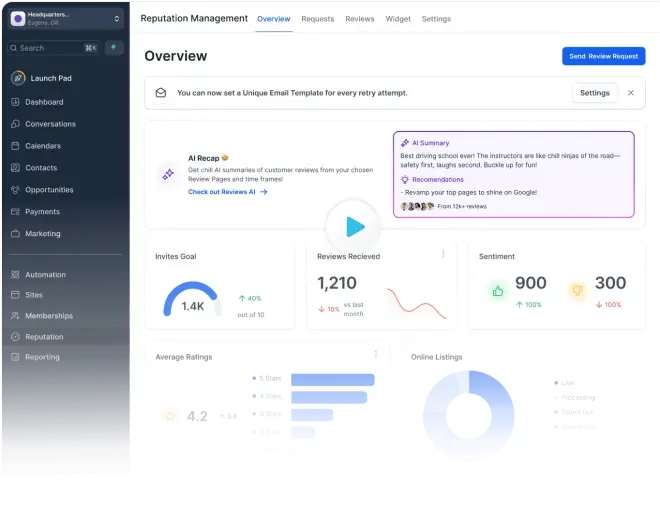
Automated review requests, review widgets, AI review replies. For local-business clients this is often the easiest thing to sell, and the dashboard gives you something to show in a monthly report.
7. Calendars and payments
Booking, paid calendars, invoicing, text-to-pay and integrations with Stripe, PayPal, NMI, Authorize.net, Square, Adyen and Razorpay. Broad payment support is a real strength for agencies working outside the United States.
8. The mobile app
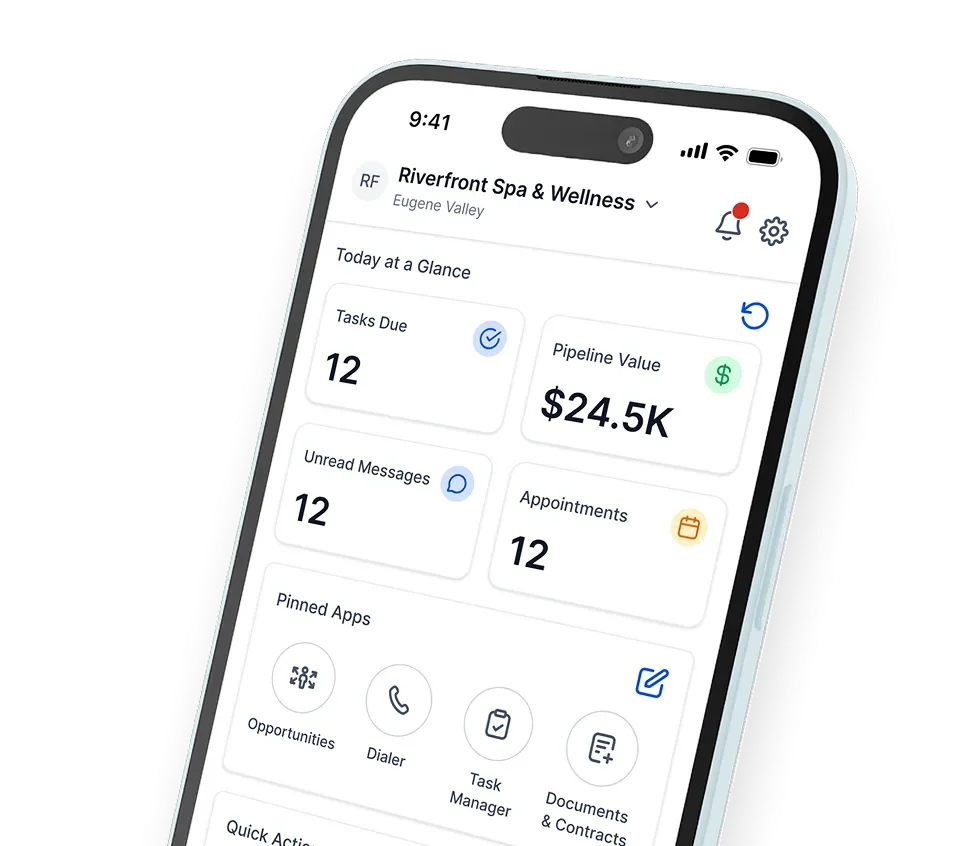
Running a client’s pipeline from a phone is the feature agency owners actually use daily. Note the distinction: the standard app is included, while putting your brand on it is the $497 a month white label add-on.
What the Pricing Page Does Not Tell You
The $1,876 comparison is the vendor’s own arithmetic
The replacement chart assigns a monthly price to each tool it claims to displace: $99 for CRM, $297 for funnels, $199 for an AI voice agent, $159 for reputation management, and so on to $1,876. Every one of those figures is HighLevel’s assertion about a competitor’s pricing, chosen by HighLevel, with no date and no link to the plans being quoted.
The comparison also runs against the $97 plan, which caps you at three sub-accounts. An agency with ten clients is on $297 before any add-ons, so the honest version of the claim for that agency is $297 against $1,876, which is still an 84 percent saving. The pitch survives the correction. It just is not the number on the chart.
Three cost layers, one headline price
Budget for all three or your forecast will be wrong: the plan, the per sub-account add-ons, and usage. Several core features carry an asterisk on the pricing page reading “Usage based charges apply”, including Conversation AI, Voice AI, Reviews AI, email and SMS marketing, and inbound and outbound calling. Those are funded from an agency wallet that you top up.
The public usage pricing page is gone
The pricing page’s asterisk points to general usage pricing. The URL that used to serve it, gohighlevel.com/usage-pricing, now redirects to a 404 page. The AI usage article still resolves. If you need per-message and per-minute rates before committing, you will have to ask sales or find them inside the app.
The numbers on the homepage have no date
The homepage counts 7,000,000 plus AI voice calls, 7,300,000,000 leads generated, 179,000,000 appointments booked and $5,200,000,000 plus in sales facilitated. Only the last carries a period, “in 2025”, which on a page read in late 2026 leaves the other three measuring an unspecified window.
A typo in the product, in their own screenshot
Small, and a fair proxy for polish: the reputation dashboard HighLevel uses to sell reputation management has a tile reading “Reviews Recieved”. It is in the marketing image, which means it is in the product.
Who Should Skip GoHighLevel
Anyone who is not reselling. If you run one business and want a funnel builder and a CRM, you are buying an agency platform to use three percent of it, and the per sub-account add-on structure gives you nothing. Point tools will cost less and do their one job better.
Anyone who needs the strongest option in any single category. This is a consolidation play, and consolidation always costs depth. If your email deliverability, your SEO tooling or your course platform is the thing your clients actually pay for, keep the specialist.
Anyone planning to switch on AI across a client base while staying on the $297 plan. You will absorb every dollar of it. Either go to $497 or leave AI off until you have three clients who will pay for it.
Anyone who needs a firm total cost before signing. Between usage-based charges, a removed public usage pricing page and an add-on menu that multiplies by client count, a precise annual figure is not something you can assemble from the website alone.
And anyone uncomfortable with platform risk. Putting your clients’ websites, funnels, CRM, phone numbers and billing inside one vendor is efficient right up until it is not, and the whole proposition here is that everything lives in one place.
Frequently Asked Questions
How much does GoHighLevel cost?
Starter is $97 a month or $970 a year and includes three sub-accounts. Unlimited is $297 a month or $2,970 a year with unlimited sub-accounts. Agency Pro is $497 a month or $4,970 a year and adds SaaS Mode and rebilling with markup. Annual billing is ten months for twelve on every tier. Add-ons and usage are extra.
Is it really $97 to replace $1,876 of software?
That is HighLevel’s comparison, using prices it selected for the tools it says it replaces, against its three sub-account plan. For a solo operator the shape of the claim holds. For an agency with more than two clients the correct base is $297, and the saving against that same $1,876 is 84 percent rather than 95.
What is a sub-account?
An isolated environment for one client, called a location in the documentation. Starter allows three. Unlimited and Agency Pro remove the cap. Seven of the optional add-ons are billed per sub-account, so the cap being removed is what makes those add-ons expensive.
Can I charge my clients for the AI features?
Only on the $497 Agency Pro plan. HighLevel’s documentation states that agencies must be on that plan to rebill AI Employee usage. On the $297 plan the agency absorbs the cost. The $200 upgrade pays for itself at three clients on AI Employee Unlimited.
Is there a free trial?
Fourteen days on any plan. Given that the economics depend on sub-account count and add-ons rather than on the core features, use the trial to build one real client environment end to end rather than to tour the feature list.
What does it integrate with?
Payment providers include Stripe, PayPal, NMI, Authorize.net, Square, Adyen and Razorpay, with an open payments infrastructure for others. WordPress hosting is a paid add-on from $10 a month per site. WhatsApp is $10 a month per sub-account.
Final Thoughts
GoHighLevel is doing something real, and the thing it does has no clean substitute. Sub-accounts with SaaS Mode let an agency sell software under its own brand without building any, and unlimited contacts and unlimited users on every tier is a genuinely generous foundation to build margin on. For an operator with a book of local-business clients, the consolidation argument mostly holds up.
What the pricing page does not do is show you the shape of the bill. One number is on the plan card. A second lives in an add-on menu that multiplies by your client count, where the AI features alone can cost three times the base plan. A third is usage, whose public rate card has been taken down. And the rule that determines whether layer two is revenue or expense sits in a support article rather than next to the plan it governs.
None of that makes it a bad platform. It makes it a platform you should model in a spreadsheet before you sign, which is the opposite of what a $97 headline invites you to do.
Three things to take: count your clients before choosing a plan, because three sub-accounts goes faster than it sounds. If you intend to sell AI features, go straight to $497, because the break-even is three clients and the alternative is absorbing the cost with no way to invoice it. And use the fourteen days to build one complete client environment, add-ons switched on, then read the projected bill, because that is the number you will actually be living with.
You can start a trial and see the current plans at GoHighLevel, which is where every figure above came from. For the same arithmetic applied to other software, our look at what an AI scheduling platform really charges per seat covers a comparable per-unit pricing trap, and the rest of our software and tools coverage sits alongside it.




Write Your Review
No reviews yet. Be the first to share your experience!