

Almost every indoor grow light is sold on one number, and it is the wrong number. Wattage tells you what the lamp draws from the wall. It does not tell you how much usable light reaches a leaf, and those two things are not as related as the listings imply.
Glowrium is a reasonable place to see how wide that gap gets, because for a handful of its lamps it publishes the right number alongside the wrong one. When you line them up, a 36W bar delivers 92 µmol/m²/s at six inches while a 48W lamp delivers 572. That is roughly a six-fold difference in light from a 33 percent difference in power draw, and nothing on the product card would warn you.
So this guide ranks the Glowrium range on what the company actually publishes: what each lamp costs, what it delivers where that is stated, which version of each model is the sensible buy, and the four or five things in the catalog that will cost you money if you do not notice them.
Quick Picks
| If you want to… | Model | Price | Why |
|---|---|---|---|
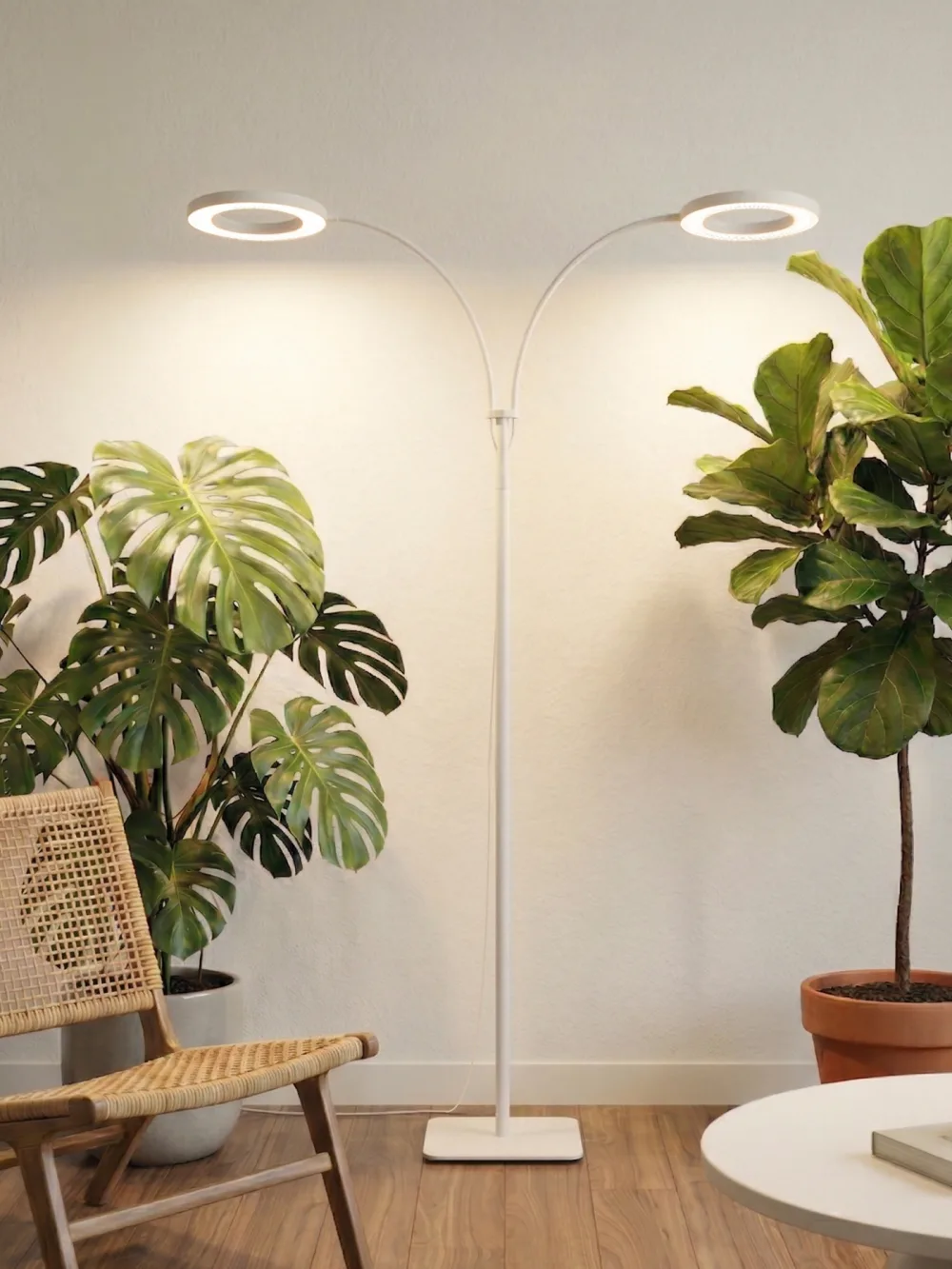
| Light one large floor plant properly | G5 48W | $79.99 | 572 µmol/m²/s at 6 in, the highest published output in the range |
| Do the same for less | G2 Pro 48W | $72.99 | 364 µmol/m²/s at 6 in, dual head, $7 cheaper |
| Cover a whole shelf of small pots | G6 six-pack | $59.99 | Cheapest watt in the lineup at $1.25, six separate strips on one controller |
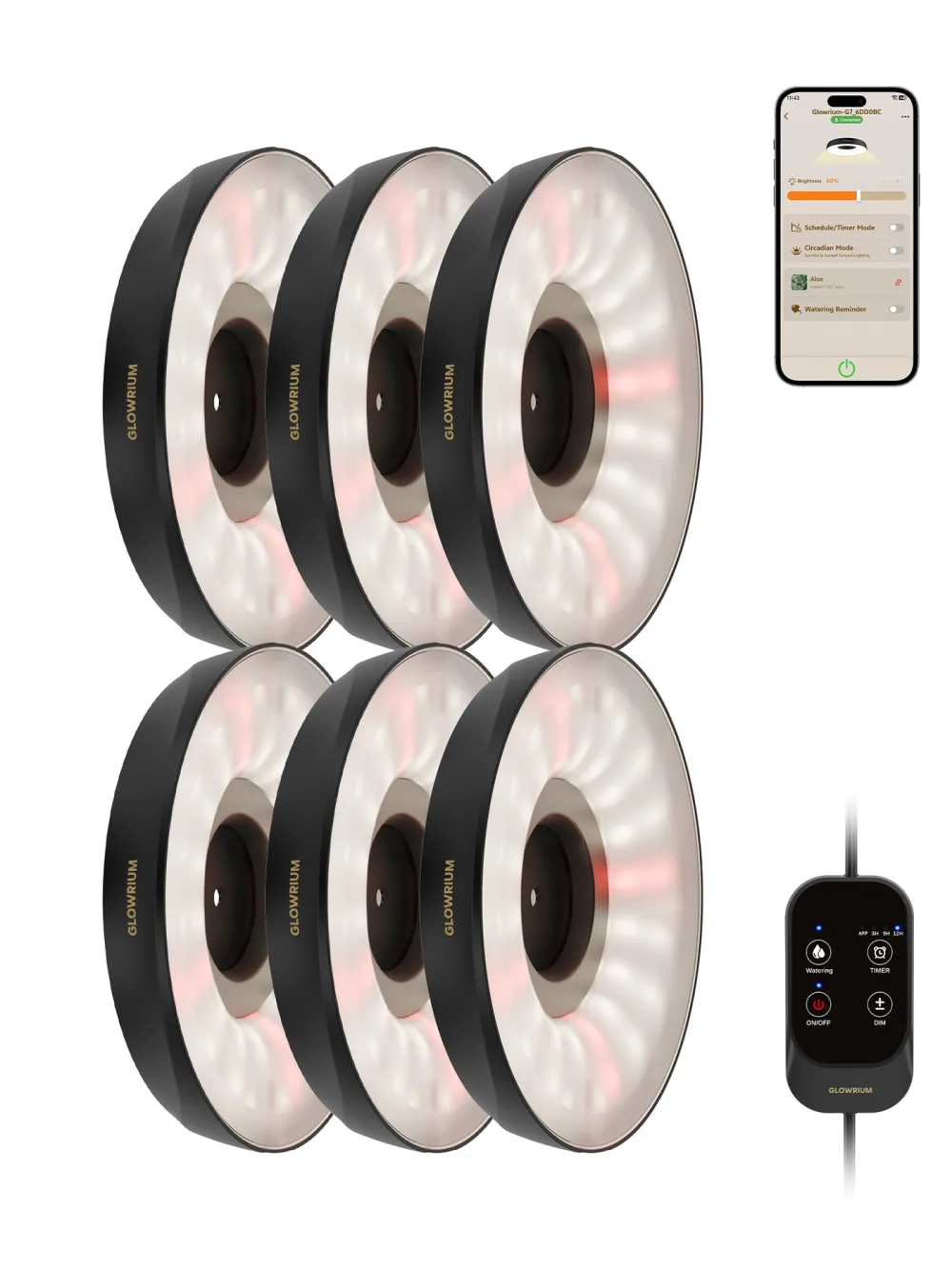
| Light pots scattered around a room | G7 six-pack | $69.99 | Six independent pucks, same daisy-chain idea in a different shape |
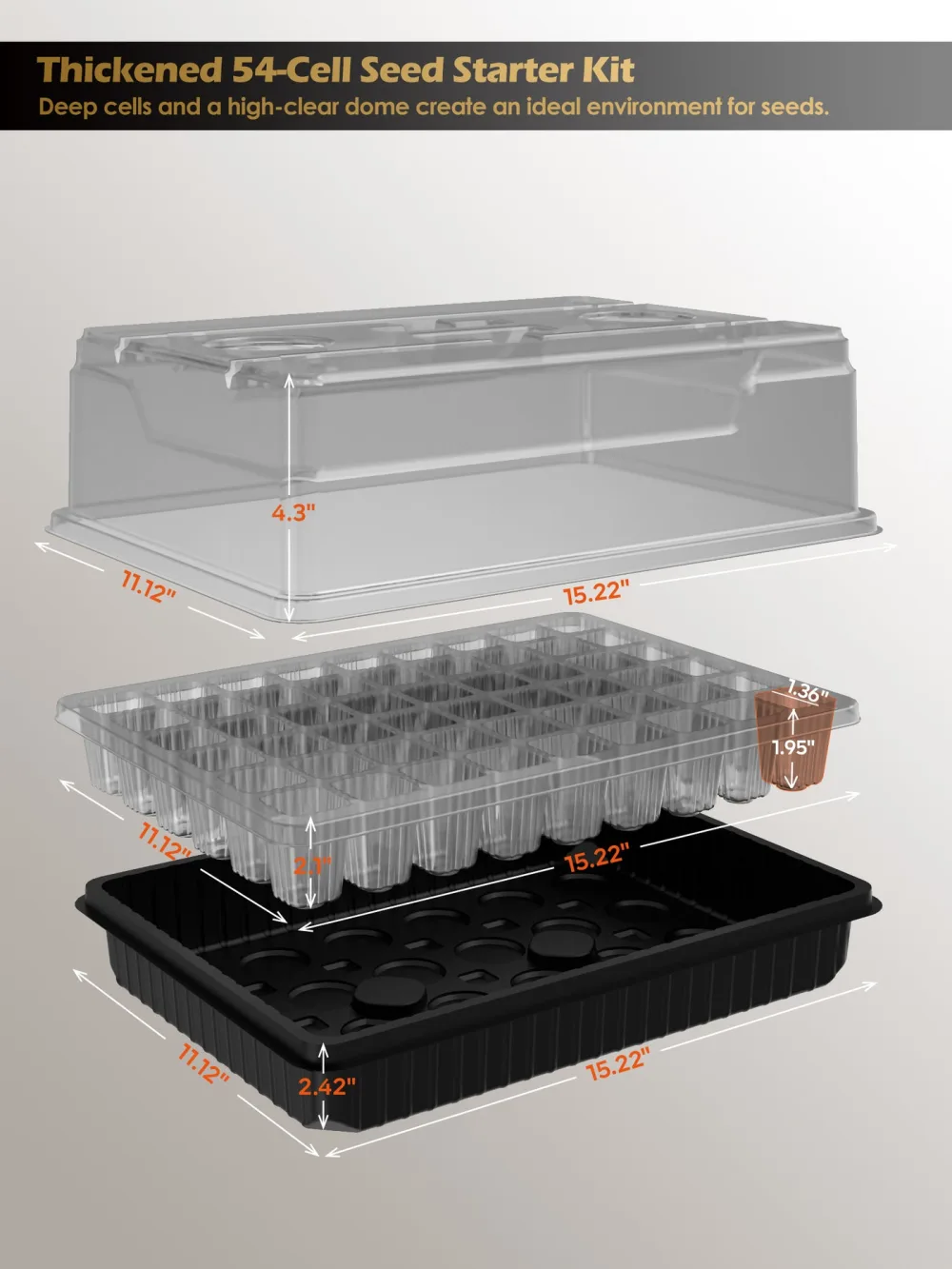
| Start seeds in spring | G9 kit, 3-pack | $59.99 | 54-cell tray, dome and lights together, 15.2 by 11.1 inches |
| Put one plant in a dark corner | G11 stand | $64.99 | Stand and light in one, no surface needed |
| Spend as little as possible | G12 6W | $25.99 | 242 µmol/m²/s at 4 in, which is respectable for a clip light |
| Buy the 20W or 24W version of anything | Do not | n/a | See the step-up table. The bigger version is always better value |
How I Checked This
Everything here comes from Glowrium’s own published product data and policy pages, read on September 5, 2026, rather than from secondary coverage or from the marketing copy on the homepage. Prices, variants, stock status and image filenames come from the store’s public product feed, which is the same data the storefront renders. Output figures, dimensions and feature claims come from the individual product descriptions. Warranty and returns come from the return policy and extended warranty pages.
I have not run these lamps against a meter, so there is no independent measurement here and nothing in this article is a test result. What this is instead is an audit of the numbers the company publishes, including the places where those numbers contradict each other, which turns out to be the more useful exercise with this particular catalog.
The Number That Actually Matters
The useful specification for a grow light is PPFD, measured in µmol/m²/s, which counts the photons a plant can photosynthesize with, at a stated distance. The distance matters enormously, because light falls off with the square of it. A PPFD figure without a distance is not a figure at all.
Glowrium publishes a PPFD value with a distance for four of its twenty-eight grow light listings. Where it does, the format is correct and specific. The problem is what the four numbers show when you put them next to each other:
| Model | Power | Price | Published output | Cost per µmol | Cost per watt |
|---|---|---|---|---|---|
| G5 | 48W | $79.99 | 572 µmol/m²/s at 6 in | $0.14 | $1.67 |
| G2 Pro | 48W | $72.99 | 364 µmol/m²/s at 6 in | $0.20 | $1.52 |
| G3 | 36W | $65.99 | 92 µmol/m²/s at 6 in | $0.72 | $1.83 |
| G12 | 6W | $25.99 | 242 µmol/m²/s at 4 in | $0.11 | $4.33 |
Rank those by cost per watt and the G2 Pro wins, the G5 is mid-table and the G12 is far and away the worst buy. Rank them by cost per unit of light actually delivered and the order changes almost completely: the G12 becomes the most efficient purchase on the page and the G3 becomes five times worse value than the G5.
One honest qualification. The G3 is a 60-inch vertical bar built to light the side of a tall plant along its whole height, not to blast one spot from above, so a single point reading at six inches is not a flattering way to describe it and is not directly comparable to a dual-head lamp aimed down at a pot. The G12’s figure is taken at four inches rather than six, which makes it look better than a like-for-like comparison would. Both caveats are real.
Neither caveat rescues the general point, which is this: wattage did not predict output in any of the four cases where both numbers exist, and for the other twenty-four listings wattage is all you get. Seven of them say “High PPFD” with no number attached. Seventeen do not mention it at all. If you are choosing between two Glowrium lamps and neither publishes a figure, you are choosing on power draw, and these four data points are the company’s own evidence that power draw is a poor guide.
Within Every Model, the Small Version Is the Bad Deal
Most Glowrium lamps come in two or three sizes, and the pricing between those sizes is remarkably consistent: the step up costs far less than the capability it buys. Using the company’s own prices:
| Model | Small | Large | Extra cost | Extra power | Cost per watt |
|---|---|---|---|---|---|
| G2 Pro | 24W, $59.99 | 48W, $72.99 | +$13.00 (+22%) | +100% | $2.50 to $1.52 |
| G5 | 24W, $69.99 | 48W, $79.99 | +$10.00 (+14%) | +100% | $2.92 to $1.67 |
| G2 | 20W, $59.99 | 36W, $65.99 | +$6.00 (+10%) | +80% | $3.00 to $1.83 |
| G6 strips | 2-pack 16W, $35.99 | 6-pack 48W, $59.99 | +$24.00 (+67%) | +200% | $2.25 to $1.25 |
| G7 pucks | 2-pack, $35.99 | 6-pack, $69.99 | +$34.00 (+94%) | +200% | $2.25 to $1.46 |
The G5 is the clearest case. Ten dollars, about fourteen percent, doubles the power. There is no scenario where the 24W G5 at $69.99 makes sense next to the 48W at $79.99, unless your ceiling height or your plant genuinely cannot take the bigger unit. The same logic applies to the 24W G2 Pro and, less dramatically, to the 20W G2.
The multipacks follow the same pattern. The G6 six-pack is the cheapest watt anywhere in the range at $1.25, and it arrives as six separate strips you can place independently, with the cable ties, mounting clips and adhesive pads in the box. That flexibility is why it is my pick for a plant shelf rather than a single plant.
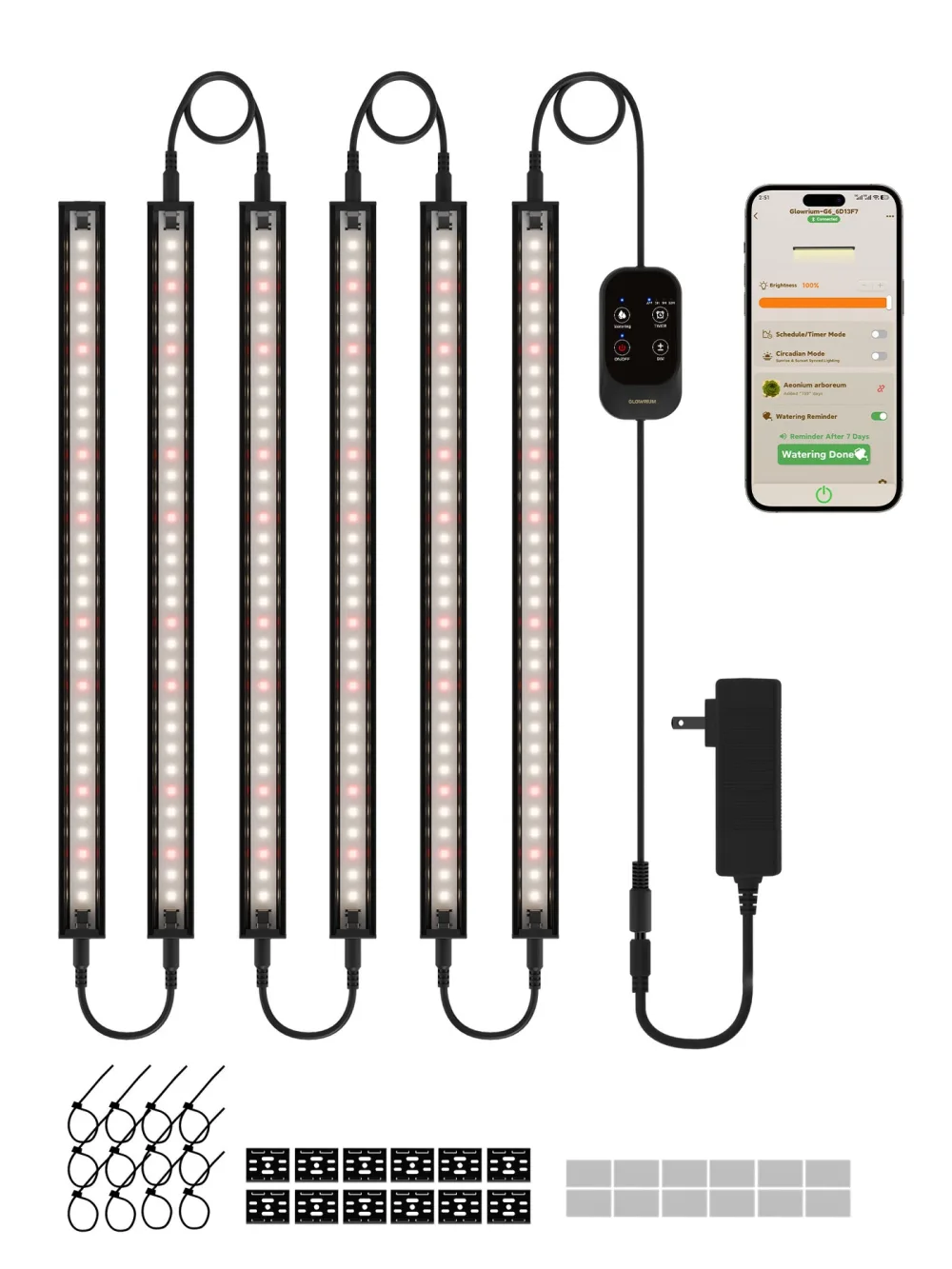
That last detail is worth absorbing before you buy either multipack. Six strips on one controller means one schedule and one brightness for the whole set. If you need two different light regimes, you need two kits, not one.
Starting seeds
The G9 kit is the one model in the range aimed at a specific job rather than a plant size. It pairs a 54-cell tray and a humidity dome with adjustable lights over the top, in a footprint of 15.22 by 11.12 inches with a 4.3 inch dome, so it fits a standard shelf. The three-light version at $59.99 works out at $2.00 per watt, which is mid-table for the range, but the comparison that matters is against buying a tray, a dome and a lamp separately.
Twenty-Eight Listings, About Twelve Lamps
The catalog has a duplication problem, and on one model it has a price consequence.
The grow light section carries twenty-seven listings typed as grow lights plus the newer G12. Grouped by model, the G2 appears under four separate live listings, the G3 under six, the G2 Pro under three, the G4 under three, the G6 under three, and the G7 and G8 under two each. Several of those are genuinely different sizes, which is fair enough. Several are the same lamp listed twice.
Here is where it costs money. The 36W G2 is sold at $65.99 on three of its listings and at $82.99 on a fourth. The 20W version is $59.99 on two listings and $70.99 on that same fourth. The expensive listing is titled with an “EUR” suffix and is evidently built for the European market, but it is live, in stock and purchasable on the US storefront, with prices shown in dollars like everything else. Land on it from a search result or a collection page and you pay 26 percent more for an identical lamp.
A smaller version of the same trap sits in the G4 listings: the 8W is priced at $45.99 and the 12W at $46.99. One dollar buys fifty percent more power. The 8W is currently out of stock, which is the only reason it is not actively costing anyone money.
What to do about it: before you check out, search the store for the model code on its own, look at every listing that comes back, and buy from the cheapest one that is in stock. That takes about thirty seconds and on the G2 it is worth seventeen dollars.
Where the Published Numbers Disagree
Three statements about how long a Glowrium lamp is covered, on three different pages of the same site:
| Source | What it says |
|---|---|
| Homepage | “ENDURING QUALITY: 2-year warranty, plus a 1-year VIP extension.” |
| Return policy page | “GLOWRIUM offers a 12-month warranty (from the day of receiving the products)” |
| Extended warranty page | Plant Light: “1 year or 2 years”. Aquarium Light: “2 years”. Home Light: “2 years” |
For a grow light buyer those are three different answers: three years, one year, or somewhere between one and two. The extended warranty page does offer “365 days of free extended warranty for all registered users”, claimed through a form that wants your model number, order number and purchase date, so the extension is real. The phrase “VIP” used on the homepage does not appear on the page that administers it.
None of this is catastrophic and the likely explanation is pages written at different times and never reconciled. But warranty length is a real part of what you are paying for, so if it matters to your decision, get the answer in writing from support before you buy rather than from whichever page you happened to read. Register the extension either way, since it is free and it is the only route to the longer figure.
On the company itself, the homepage says “Two Decades of LED Excellence”. The about page is more precise and more modest: the founder “first entered the lighting industry” in 1999, and “the GLOWRIUM brand was officially established in 2022”. The two decades belong to a career, not to the brand, and the about page is straightforward about that. The storefront’s oldest product listing dates from January 2024.
Things Worth Knowing Before You Buy
Some product photos are AI-generated
Across the catalog, 61 of 453 product images, about 13.5 percent, carry filenames in ChatGPT’s image export format. For most lamps that is one or two supporting images among eight or nine real product shots, which is unremarkable.
For four products it is every single image. The floral canvas tote bag, the plant lover gift set, the repotting mat and the three-piece garden tool set have no photographs at all, only renders. Looking at the tote bag listing confirms it: the book spines in the styled background read as garbled lettering, and the slogan printed on the bag floats across the floral pattern without following the curve of the fabric.

The lamps themselves are overwhelmingly shown in real product photography and detailed spec diagrams, so this is not a catalog-wide problem. It matters for the accessories, where you cannot see the thing you are buying.
No safety certifications are stated
I checked the about, promise, return policy and extended warranty pages and found no mention of UL, ETL, FCC, CE, RoHS or Energy Star. These are mains-powered devices intended to run unattended for twelve hours a day, often near water and soil, so a stated certification would be reassuring. Absence from those four pages is not proof the products lack certification, and the marks may well appear on the units or their packaging. It does mean you cannot confirm it from the website before ordering, and that is worth an email to support if it matters to you.
“Risk-free” costs the return postage
The homepage promises a “RISK-FREE TRIAL: 30 days to love it.” The return policy is more specific. You have 30 days, items must be “unused, undamaged and in the original product packaging”, and on returns that are not the company’s fault “it is your responsibility to get the item back to us safely”. Refunds go only to the original card, within 7 to 15 days of approval. There is no restocking fee mentioned, which is good, but a change-of-mind return will cost you shipping both ways.
Eight listings are out of stock
Eight of the 77 products in the catalog have every variant unavailable, including two H-series floor lamps and the G4 8W. They remain listed and indexed, so you can land on one from a search result, read the whole page and only discover the position at the end.
The discount stacks by quantity
A site-wide banner offers “Buy 1 Save 10% • Buy 2 Save 15% • Buy 3+ Save 20%”. If you are furnishing more than one plant corner, that tier is worth more than choosing a cheaper model, and it combines naturally with the step-up logic above: three of the better lamps at 20 percent off will beat three of the cheaper ones at full price on both output and money.
What the Rest of the Range Is Like
Grow lights are the core of the business, but roughly a third of the catalog is ordinary home lighting: floor lamps in the H series, a corner RGB lamp, a reading lamp, plus a small aquarium line. The G11 plant stand sits across both worlds, putting the light on its own stand so you do not need a shelf or a side table for it.
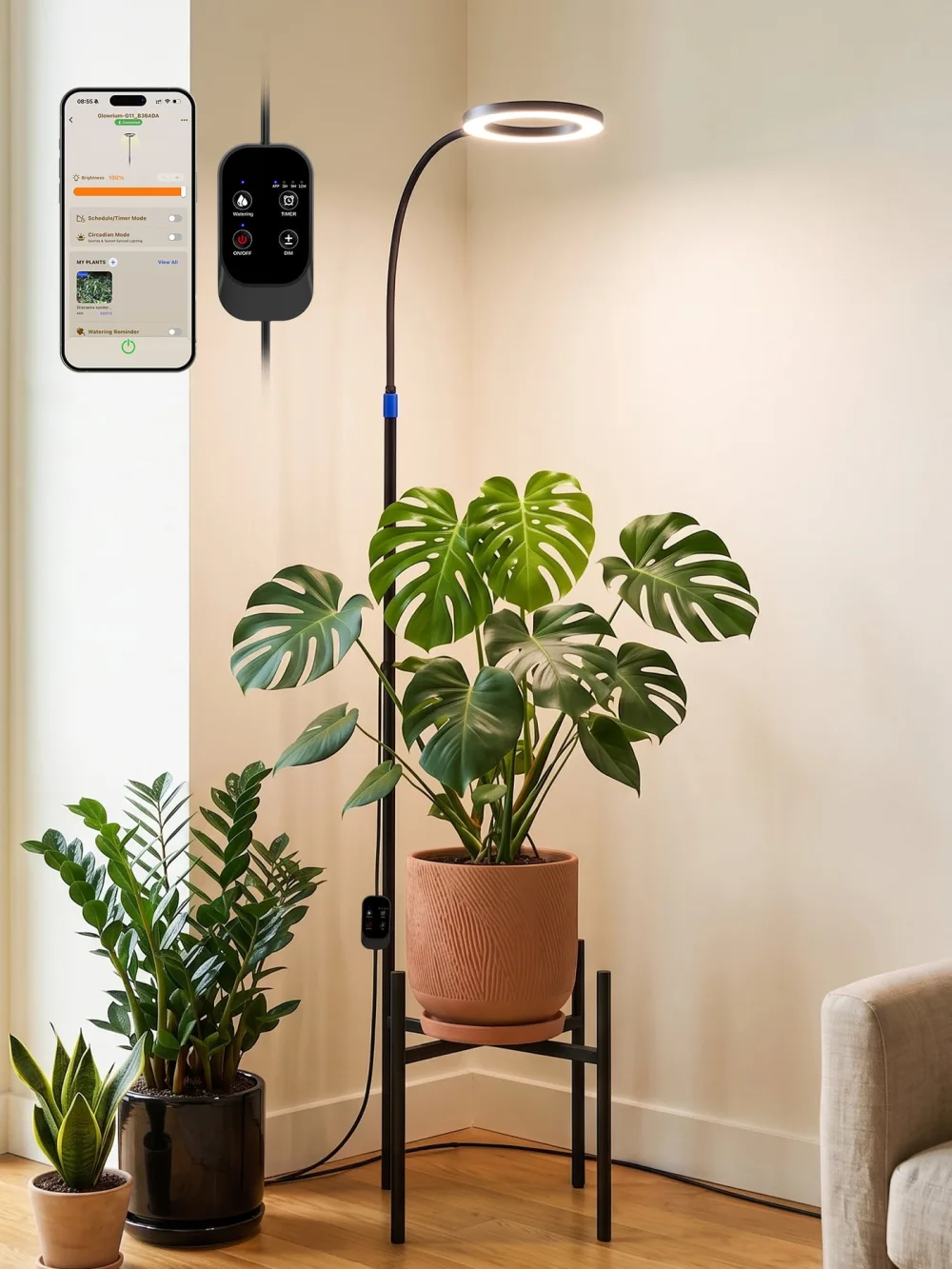
Across the smart models the app does the same handful of things: brightness, a 3, 9 or 12 hour timer, a watering reminder, and a “circadian mode” that follows your local sunrise and sunset. That last feature is the most genuinely useful one in the lineup, because the single most common way to kill a plant with a grow light is to leave it on continuously. Every smart model also has a physical inline controller, so the lamp still works if the app or the account stops being supported, which is more future-proofing than this category usually offers.
Who Should Skip These
- Anyone growing anything that fruits. This is supplemental houseplant and seedling lighting. Tomatoes, peppers and cannabis need far more intensity than a 48W consumer lamp delivers, and nothing in this range is built for a grow tent.
- Anyone who needs to compare on specifications. Twenty-four of twenty-eight listings publish no output figure. If you want to shop on numbers, most of this catalog does not give you any to shop on.
- People who want the lamp to disappear. These are visible pieces of hardware with visible cables. The G2 and G5 are poles in the middle of a room.
- Anyone who needs independent control per plant. Multipacks share a single controller. Six pucks, one schedule.
- Shoppers who will not check for a duplicate listing. It is a thirty second job that can save a quarter of the price, but if you buy the first result you see, you may be the person paying $82.99 for the $65.99 lamp.
Frequently Asked Questions
What do Glowrium grow lights cost?
The grow light range runs from $25.99 for the 6W G12 to $82.99 for the most expensive G2 listing, with most of the useful models between $59.99 and $79.99. Multipacks of the G6 strips and G7 pucks start at $35.99 for two and top out at $69.99 for six.
Which one should I buy for a single large plant?
The G5 48W at $79.99 publishes the highest output in the range, 572 µmol/m²/s at six inches. The G2 Pro 48W at $72.99 publishes 364 at the same distance and costs $7 less. Both are dual-head floor lamps on adjustable poles.
Is the cheaper version of a model ever worth it?
Rarely. Across the G2, G2 Pro, G5, G6 and G7, the larger version costs between 10 and 94 percent more and delivers between 80 and 200 percent more power. Buy the small one only if the space genuinely will not take the big one.
What is the warranty?
It depends which page you read, which is the problem. The homepage says two years plus a one-year extension, the return policy says 12 months, and the extended warranty page says plant lights are covered for “1 year or 2 years”. Registering for the free 365-day extension is free and worth doing regardless.
Do they work without the app?
Yes. Every smart model ships with a physical inline controller that handles power, dimming, the timer and the watering reminder, so the hardware does not depend on the account staying online.
Can I leave a grow light on all the time?
No, and you should not. Plants need a dark period, and continuous light is a common way to stress a houseplant. Use the 3, 9 or 12 hour timer or the circadian mode, which follows local sunrise and sunset automatically.
Are the product photos real?
For the lamps, mostly yes. Across the whole catalog about 13.5 percent of images carry AI generation filenames, and for four accessory products, the tote bag, gift set, repotting mat and tool set, every image is a render.
Final Thoughts
The hardware here looks sensible for what it is. Circadian scheduling that tracks real sunrise and sunset is a better idea than a dumb timer, keeping a physical controller on every smart model is the right instinct, and pricing the step-up sizes so gently that the big one is always better value is, whether deliberate or not, generous to anyone who notices.
What lets it down is the presentation. The same lamp sits under four listings at two different prices, the warranty is stated three incompatible ways, and the one specification that would let a buyer compare anything is published for four listings out of twenty-eight. None of that is a product problem. All of it is a buyer problem, because it shifts the work of figuring out what you are purchasing onto you.
So do the small amount of homework. Search the model code before you check out and buy the cheapest live listing. Take the bigger version of whatever model you choose. If output matters, restrict yourself to the four lamps that publish a figure with a distance attached. Register the warranty extension. Done in that order, this is a decent range at fair prices, and the G5 48W and the G6 six-pack are the two I would put money on. If you are setting up an indoor growing space more broadly, a soil moisture meter will tell you more about why a plant is struggling than another lamp will, and the rest of our garden coverage goes further into the setup around it.
You can see the current range and the quantity discount tiers on Glowrium’s store, and if you are buying more than one lamp, compare the three-unit price against a single better model before you decide.


Write Your Review
No reviews yet. Be the first to share your experience!