

LEGO Technic has a power problem, and it is not that the motors are weak.
The problem is what drives them. A standard battery box puts out a fixed, conservative amount of current, an infrared receiver needs line of sight and gives up in sunlight, and the whole arrangement takes up a brick of space that your model probably needed for something else. Then LEGO retired Power Functions in favour of the Powered Up system, which left a very large number of people holding motors that still work perfectly and no modern way to drive them.
A third-party Bluetooth hub solves all of that at once. It is a rechargeable battery and a radio receiver in a single brick, it talks to your phone instead of a plastic remote, and it is not limited to the current LEGO decided was sensible.
BuWizz is the best known of these, and the one with the longest track record. This guide covers which of its hubs to buy, the one decision that actually matters, and four things worth knowing before you spend what is, by any measure, a lot of money on a brick.
Quick Picks
| If you want… | Buy this | Price |
|---|---|---|
| The one to buy, for almost everyone | BuWizz 3.0 Pro | €199 |
| A hub plus the motors to use it | 3.0 Pro + 2 × BuWizz Motor | €239 |
| More power than a LEGO Buggy Motor | BuWizz Motor, each | €29 |
| To spend less, with real compromises | BuWizz 2.0 | €149 |
| Two independent models running at once | 2 × BuWizz 3.0 Pro | Bundle priced |
Prices as listed in July 2026 and quoted before VAT. See the pricing section below, because that detail changes the number quite a lot depending on where you live.
What a Bluetooth Hub Actually Replaces
It is worth being concrete, because “smart LEGO battery” is vague and the thing it does is specific. One BuWizz brick takes the place of three separate things in a traditional Power Functions build:
- The battery box. Built-in rechargeable Li-Po rather than six AA cells you keep replacing.
- The IR receiver. Bluetooth instead, so no line of sight and no dead zone in bright sun.
- The remote. Your phone, with a layout you design yourself.
That is three bricks of space recovered and one charging cable instead of a drawer of batteries. For a model where every stud is accounted for, which is most Technic supercars, that alone is a reason to consider it.
The second thing it changes is how much current reaches the motors. The brand’s headline claim is that it delivers several times the power a standard LEGO battery box will give the same motor, and the performance difference in practice is the main reason the product has a following in the remote-control building community.
The Only Decision That Really Matters
There are two hubs in the range. The spec gap between them is wide and the price gap is narrow, which makes this simpler than it looks.
| BuWizz 2.0 | BuWizz 3.0 Pro | |
|---|---|---|
| Price | €149 | €199 |
| Ports | Power Functions only | 4 Powered Up plus 2 Power Functions |
| Battery | Rechargeable Li-Po | 2300 mAh, 8.5 Wh Li-Po |
| Charging | Older connector | USB-C fast charging |
| Range | Shorter | Up to 100 m |
| Current sensing | No | On all 6 ports |
| Lighting | — | 4 programmable RGB LEDs |
| Custom app controllers | Limited | Yes |
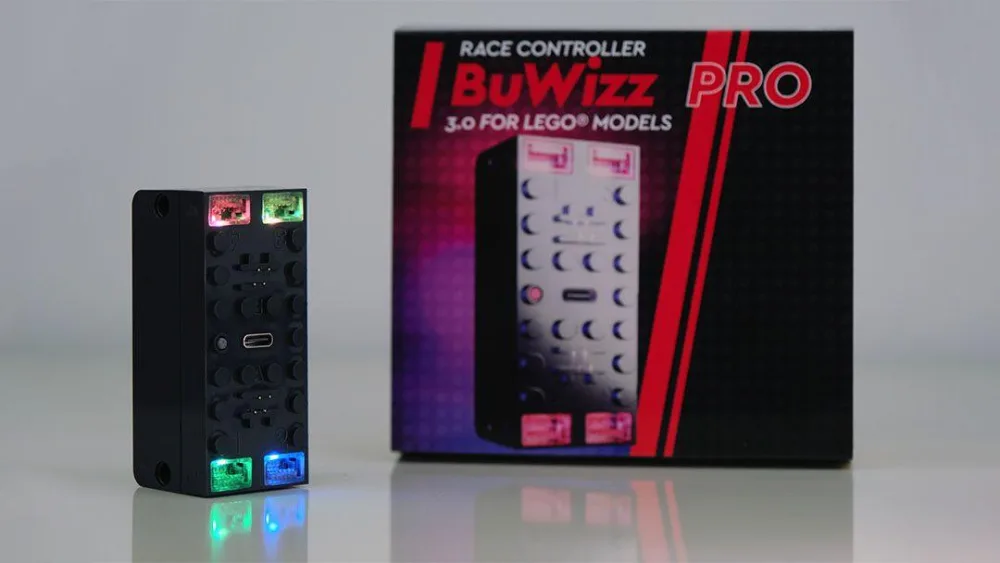
BuWizz 3.0 Pro, €199 — the answer for almost everyone

Six ports, and the split is the important part: four of them drive Powered Up motors or sensors, two drive Power Functions motors. That combination is the whole argument for this product. It is the bridge between the system LEGO abandoned and the system LEGO replaced it with, and it means a parts collection accumulated over fifteen years all works on one brick.
The rest of the spec is what you would expect at the price. A 2300 mAh, 8.5 Wh battery, USB-C charging rather than a proprietary cable, Bluetooth good for about 100 metres, four programmable RGB LEDs, and current sensors on every port.
Those current sensors are quietly the most interesting feature, because they let the app show you what the model is actually doing rather than what you told it to do. Combined with the custom controller builder, you get sliders, buttons, joysticks and a tilt control that you assign to specific ports and label yourself, plus readouts including g-meters and voltage.
That matters more than it sounds. The Lego Car Blog, which has reviewed BuWizz hardware since the original, was explicit that controller customisation was the thing missing from the 2.0 era software and that the 3.0 Pro brought it into line with its main competitor. The same review rated the hardware five stars and described the plastic quality as excellent, noting only that it is perhaps slightly shinier than a genuine LEGO part while otherwise matching it.
Skip it if: you have one small model and no plan to build more. This is an investment in a system, not an accessory for a single build.
BuWizz 2.0, €149 — hard to recommend
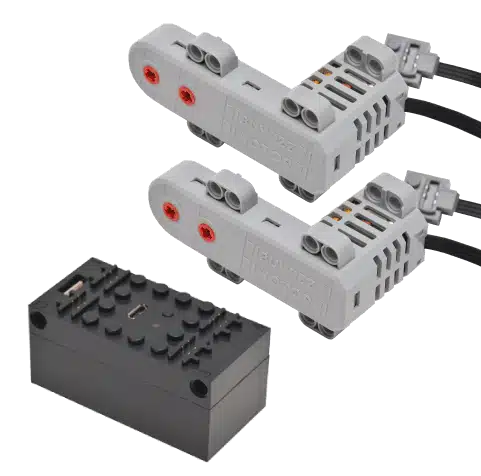
The older hub is still sold, and on paper €50 less is a meaningful saving on a €199 product. In practice I struggle to make the case for it.
For that €50 you give up Powered Up compatibility entirely, USB-C charging, the current sensors, the RGB lighting, a good deal of range, and the custom controller builder that is the main reason the app is worth using. That is not a trim level. That is most of the product.
If €149 is genuinely your ceiling, the honest advice is to wait and buy the 3.0 Pro rather than to spend €149 on a hub that cannot drive the motors LEGO currently sells. The gap is one Technic set, and the thing you are buying is meant to last across many of them.
Buy it only if: your entire collection is Power Functions, you are certain it will stay that way, and you want the cheapest route to Bluetooth control.
BuWizz Motor, €29 each — the sensible add-on
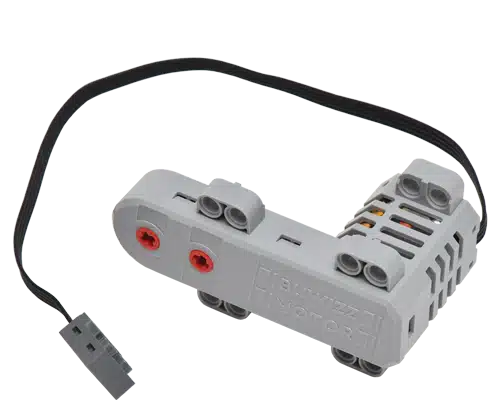
The motor is designed as a direct substitute for LEGO’s discontinued Buggy Motor. It matches the Buggy Motor’s dimensions, weight and connections, so it drops into existing builds and instructions without redesign, and the brand puts its output at about 20% above the part it replaces.
At €29 this is the least painful purchase in the range and the one that makes the hub worth having. A hub with nothing good to drive is an expensive battery.
The bundle to look at is the 3.0 Pro with two motors at €239. Bought separately that is €199 plus €58, so the bundle saves €18. Not dramatic, but if you were buying two motors anyway it is free money.
Four Things to Know Before You Buy
1. The prices are quoted before VAT
This is a European company and the figures on the shop are listed excluding VAT. If you are buying within the EU, the number you pay at checkout will be meaningfully higher than €199 once your national rate is applied, and in several member states that is an extra fifth on top.
Buyers outside the EU may see the pre-VAT figure but should expect their own import duty and handling charges instead, which are easy to forget and occasionally unpleasant. Either way, budget above the sticker rather than at it.
Worth noting too that free shipping starts at €500, which is a high threshold on a catalogue where the flagship product is €199. Most single-hub orders will pay postage.
2. It is genuinely expensive, and that is the main criticism
Let me not dance around this. €199 before tax for a battery brick is more than a lot of complete Technic sets cost. The most consistent complaint about BuWizz in building forums is not that it fails to work, it is the price, and that criticism is fair rather than unreasonable.
The counter-argument is that it is reusable indefinitely. A hub moves from model to model for years, which is not true of the set it costs the same as. Whether that maths works depends entirely on whether you are a person who builds one motorised model or a person who builds many. If you already own several Technic sets with motors in them, the cost per build drops fast. If this would be your first, it will not.
3. More power goes through parts that were not designed for it
The selling point of this category is that it pushes far more current to a LEGO motor than LEGO’s own battery box will. That works, and it is why the product exists. It also means more torque arriving at gears, axles and differentials made of ABS plastic to a specification set with the standard battery box in mind.
Nothing about this is a defect in the hub. It is simply what happens when you increase the input to a drivetrain. Stripped gears and twisted axles are a known part of high-power LEGO building, and if you intend to run at the top of the power range, expect to replace some parts and to reinforce drivetrains that were marginal to begin with. Start at a lower power setting on a new model and work up rather than going straight to maximum on a build you spent a month on.
4. It is not the only option
The most commonly named alternative is SBrick, which the review coverage treats as BuWizz’s principal competitor, and it was ahead on controller customisation for a period before the 3.0 Pro closed that gap. LEGO’s own Powered Up hub is also a real option if your collection is entirely modern, you do not need extra power, and you would rather stay inside the official ecosystem with the warranty that implies.
The case for BuWizz specifically is the combination of both motor systems on one brick plus the power headroom. If you do not need either of those things, you can spend less.
Frequently Asked Questions
Will it work with my old Power Functions motors?
Yes, and that is a large part of the point. The 3.0 Pro has two Power Functions ports alongside four Powered Up ports, so a mixed collection runs on one hub. The older 2.0 handles Power Functions only.
Does it work with LEGO’s newer Powered Up motors?
On the 3.0 Pro, yes, up to four Powered Up motors or sensors. On the 2.0, no. This is the single biggest reason to pay the extra €50.
How long does the battery last?
The 3.0 Pro carries a 2300 mAh, 8.5 Wh cell and charges over USB-C. Actual runtime depends entirely on how hard you drive the motors, which is the honest answer rather than an evasive one: a hub at high power on a heavy model is a completely different load from one running lights and a steering servo.
Is it worth it over LEGO’s own hub?
Only if you need what it does differently. If your collection is entirely Powered Up and you are happy with stock performance, the official hub is cheaper and inside the system. BuWizz earns its price when you need both motor generations on one brick, more power than standard, or the custom controller app.
Will using it damage my LEGO parts?
The hub will not. Running a plastic drivetrain at several times the power it was designed around increases wear on gears and axles, which is a consequence of the power rather than a fault in the product. Build in some reinforcement and start at lower power settings on a new model.
Final Thoughts
This is a narrow product aimed at a specific person, and it is excellent for that person and poor value for anybody else.
If you build motorised Technic regularly and own motors from both the Power Functions and Powered Up eras, the BuWizz 3.0 Pro at €199 is the buy, and the thing you are really paying for is not the power but the fact that one brick runs both generations of your collection. Six ports, USB-C, current sensing on all of them, and an app you can lay out yourself.
Add BuWizz Motors at €29 each, because a hub with nothing worth driving is an expensive battery, and take the 3.0 Pro with two motors at €239 if you were buying a pair anyway, since the bundle saves €18 over buying them separately.
I would leave the BuWizz 2.0 at €149 alone unless your collection is Power Functions and will stay that way. Fifty euros is not enough of a saving to give up Powered Up compatibility, USB-C, current sensing and the controller builder all at once.
And go in with the price understood properly. The listed figures exclude VAT, free shipping does not start until €500, and the forum consensus that this is a lot of money for a brick is correct. It is a reusable brick, which is the whole defence, and that defence only works if you are going to keep building.
Check current pricing at BuWizz →
Prices and specifications were taken from publicly listed product information in July 2026, are quoted before VAT, and change without notice. Independent review observations are from The Lego Car Blog. LEGO, Technic, Power Functions and Powered Up are trademarks of the LEGO Group, which does not sponsor or endorse BuWizz or this article.







Write Your Review
No reviews yet. Be the first to share your experience!